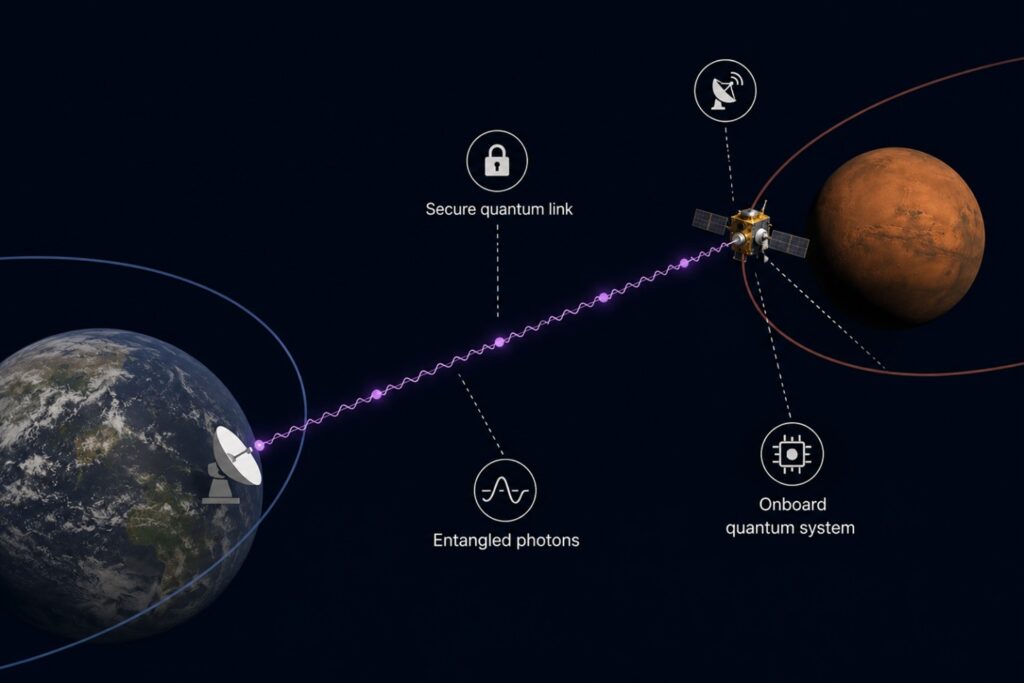
Quantum technologies are expected to play a central role in future space infrastructures, enabling ultra-secure communications, distributed sensing, autonomous navigation, and next-generation onboard computing. One of the main challenges preventing the deployment of practical quantum systems is their extreme sensitivity to noise, decoherence, radiation effects, and hardware imperfections. Quantum Error Correction (QEC) is therefore a key enabling technology for reliable quantum operations in harsh and uncertain environments such as deep space.
This thesis focuses on the modelling and autonomous correction of quantum errors using AI-enhanced decoding strategies inspired by ongoing activities at NASA JPL in robust neural-network-based quantum decoders. The student will investigate realistic quantum noise models, correlated and non-Markovian error propagation, fault-tolerant decoding algorithms, and resource-constrained real-time correction architectures. Particular attention will be devoted to the integration of machine learning techniques for syndrome interpretation and adaptive error mitigation under limited computational resources.