
The German Aerospace Center (DLR) (Deutsches Zentrum für Luft- und Raumfahrt) is Germany’s national research center for aeronautics, space, energy, transport, and related technologies.
DLR is offering Master’s thesis opportunities focusing on robotics, motion planning, mechanical design, and experimental validation, including applications in space robotics. The proposed topics are listed below.
Contacts: send an email to francesco.braghin@polimi.it, specifying the topic you’re interested in.
1. Design of a interface for robotic pick up operations in space
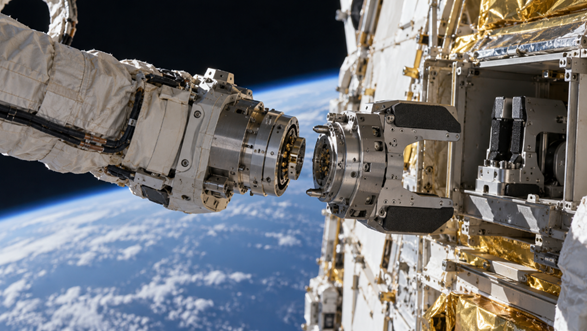
The goal is the development of prototype of a robotic tool exchanger for in-space usage, fulfilling some requirements covering mass, accuracy, usability, safety, and thermal performance. Several design concepts shall be compared and assessed by analysis and testing on prototypes. Required: CAD expertise, high interest in mechanical design.
2. Automated Decomposition of Collision Meshes into Primitives
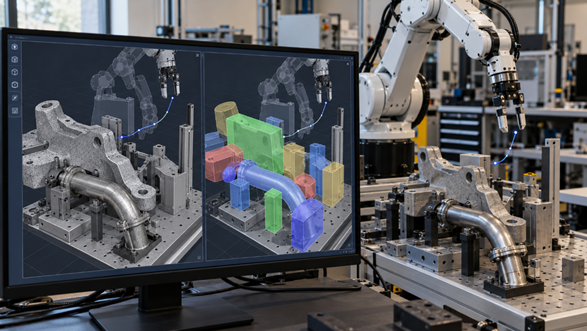
Motion planners help to obtain collision-free motions for robots. Modern parallelized motion planners represent the environment as primitive shapes, but converting collision meshes into a functional multi-primitive decomposition is today a time-intensive manual job. The thesis would automate this decomposition under motion-planning constraints. Required: experience in Python, CAD expertise.
3. SIMD Accelerated Probabilistic Kinematics for robotic motion planning
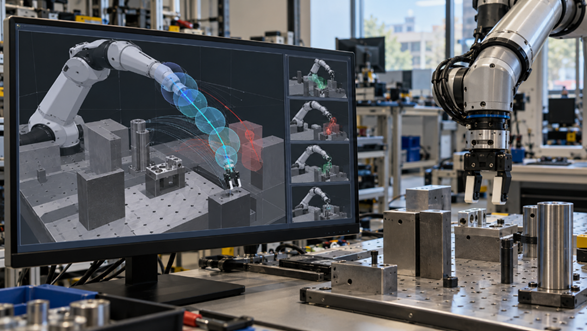
A probabilistic kinematics framework models real-robot accuracy errors as probability distributions propagated to the end-effector pose but has so far not been used for collision checking e.g. to avoid objects whose pose is only approximately known. The goal of the thesis is to combine a probabilistic description of the motion plan with SIMD (Single Input, Multiple Data, for CPU speed ups)-accelerated collision checking in order to gain efficiency and speed up the motion planning process. Requires: experience in Python or C++
4. Motion path planning for a intra vehicular robot
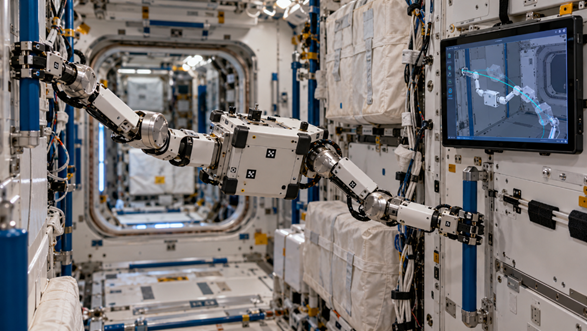
A robot with two arms is currently designed for working inside the International Space Station (ISS). The thesis will work on implementing in simulation a motion planner for this robot (i.e. planning motions for moving to a desired position while avoiding collisions). The plans will be experimentally validated with a physical robot prototype. Requires knowledge of Matlab/Simulink or Python, robot dynamics.
5. Development and Experimental Validation of an Articulated Palm for a Robotic Hand
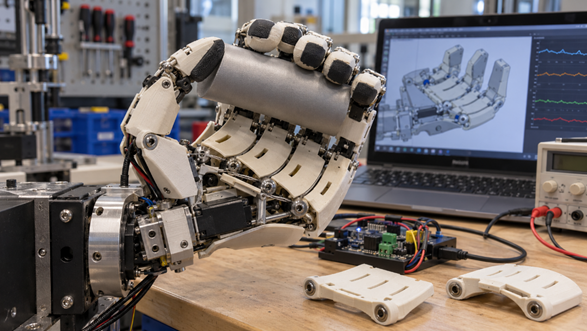
Focuses on the CAD design, sensor/actuator integration, and rapid prototyping of an articulated palm mechanism to enable hand flexion. The student will build a physical prototype using microcontroller/ROS control and experimentally validate its grasping performance. Required: CAD expertise, high interest in mechanical design.
6. Design and Mechanical Integration of a Holistic Skin for an Articulated Hand
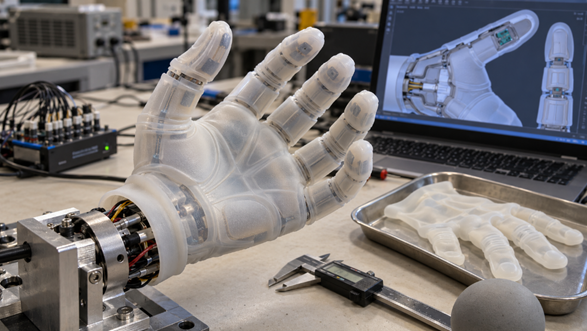
Focuses on designing and mounting a flexible, silicone 3D-printed skin onto an articulated robotic hand while managing cable routing and joint friction. The student will assemble the prototype and experimentally test its fit, range of motion, and sensor placement. Required: CAD expertise, high interest in mechanical design.