
Abbreviations
- ROM: Reduced Order Model
- SSM: Spectral SubManifold
- FE: Finite Element
- DOFs: Degrees of Freedom
Context
Complex mechanical structures are typically analysed using FE models with hundreds of thousands to millions of DOFs. Computing their nonlinear dynamic response can be prohibitively expensive, as internal forces and, for implicit solvers, tangent stiffness matrices must be repeatedly evaluated during time integration. Reduced-order models address this challenge by describing the dynamics through a small number of dominant coordinates, extending the idea of modal reduction to nonlinear systems. In particular, SSM-based methods provide a systematic framework for constructing nonlinear ROMs and efficiently computing the frequency response of large FE models.
Project
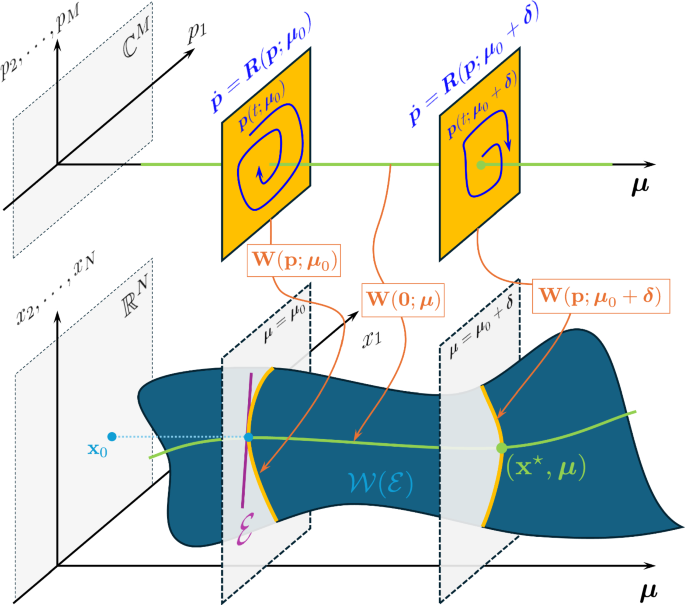
Although SSM-based ROMs enable efficient simulations, their construction can still be computationally demanding. A recently developed parametric formulation addresses this limitation by incorporating parameter dependence into the reduced model [1]. A single ROM can thus be used to explore multiple configurations without repeating the reduction for each parameter value.
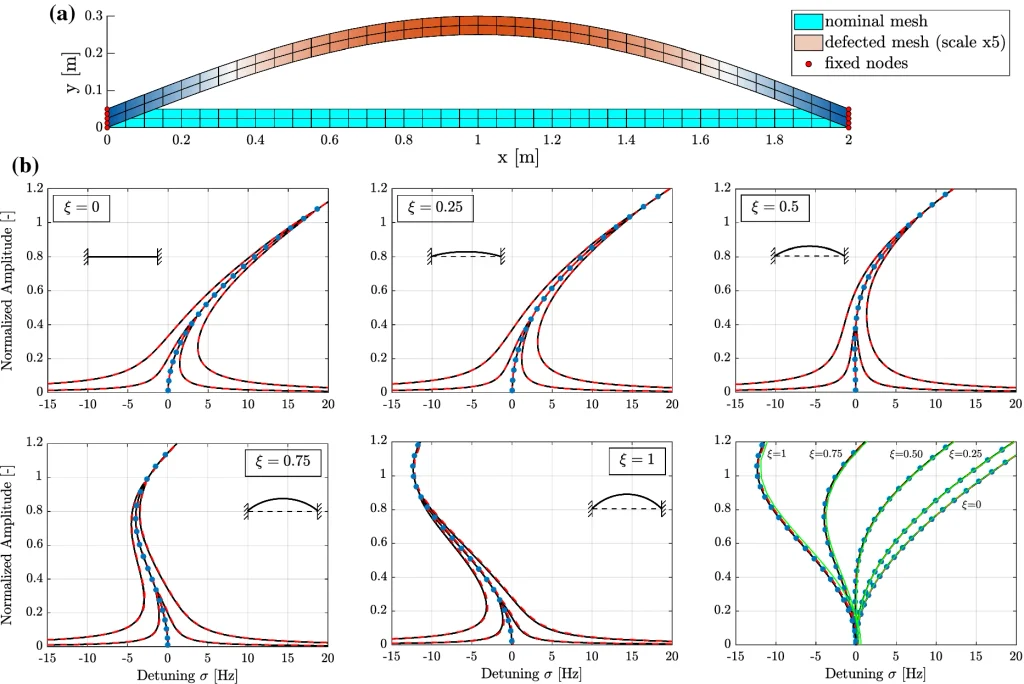
However, the formulation considered in [1] relies on an affine dependence of the governing equations on the parameters, which complicates its direct application to variations in structural geometry. Accounting for these variations is essential to assess whether a design remains effective in the presence of manufacturing imperfections. Even small geometric defects can substantially alter the nonlinear frequency response, as demonstrated in [2]. Predicting their influence is particularly relevant to MEMS devices, whose performance can be highly sensitive to geometric imperfections.
This master’s thesis aims to combine a geometric parametrization inspired by [2] with the parametric SSM formulation developed in [1]. The student will develop, implement and validate the resulting approach on representative FE models, assessing its accuracy and computational efficiency. The goal is to enable rapid exploration of geometric variations and their effects on nonlinear dynamics.
References
[1] Jain, S., Li, M. Computing parameter-dependent invariant manifolds for data-free nonlinear model reduction. Nonlinear Dyn 114, 1012 (2026). https://doi.org/10.1007/s11071-026-12814-z
[2] Marconi, J., Tiso, P., Quadrelli, D.E. et al. A higher-order parametric nonlinear reduced-order model for imperfect structures using Neumann expansion. Nonlinear Dyn 104, 3039–3063 (2021). https://doi.org/10.1007/s11071-021-06496-y
Prerequisites
- A course in nonlinear dynamics
- Basic knowledge of the finite element method
- Proficiency in MATLAB
- Strong motivation for computational research
Contacts
For further information or to apply, please contact:
- Jacopo Marconi (jacopo.marconi@polimi.it)
- Shobhit Jain (shobhit.jain@tudelft.nl)
Optionally, the work can partially be carried out at TU Delft.