
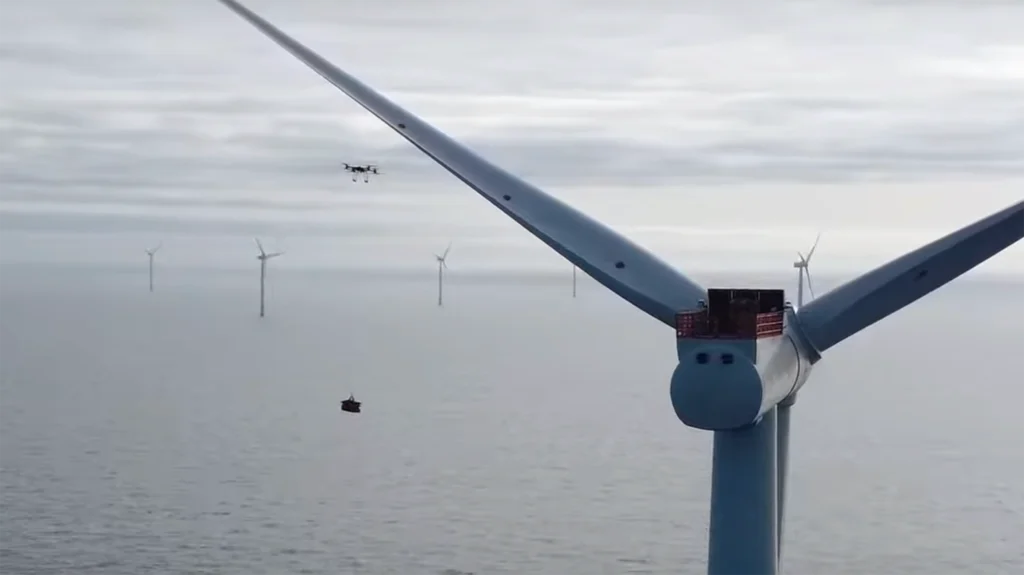
The use of drones in wind farms offers significant opportunities for automated inspection, measurements of the atmospheric wind, and the transport of tools and equipment. In these applications, drones may operate close to wind turbines and therefore encounter a highly complex aerodynamic environment characterized by atmospheric turbulence, wind shear, and the unsteady wakes generated by turbine rotors.
Wind turbine wakes are characterized by reduced mean wind velocity, increased turbulence, strong velocity gradients, and coherent vortical structures. These flow features can significantly affect the aerodynamic performance of a multirotor drone, producing fluctuations in rotor thrust and power and increased control effort and energy consumption. Understanding these interactions is therefore important for enabling safe, efficient, and autonomous drone operations within wind farms.
The objective of this thesis is to investigate the aerodynamic behavior of multirotor drones operating in the complex flow environment generated by wind turbines. Representative turbine-wake conditions will be used to characterize the non-uniform and unsteady inflow experienced by the drone, and an established aerodynamic solver will be employed to evaluate the response of the drone rotors under different wake conditions, vehicle positions, orientations, and flight conditions. Particular attention will be given to the influence of flow features on rotor loads, vehicle-level forces and moments, power consumption, and flight stability.
Based on the aerodynamic analysis, the thesis will identify the flow conditions and flight configurations that are most critical for drone operation and investigate strategies for improving aerodynamic performance.
Required background: basic knowledge of aerodynamics, basic MATLAB programming skills.
Contact: alessandro.fontanella@polimi.it