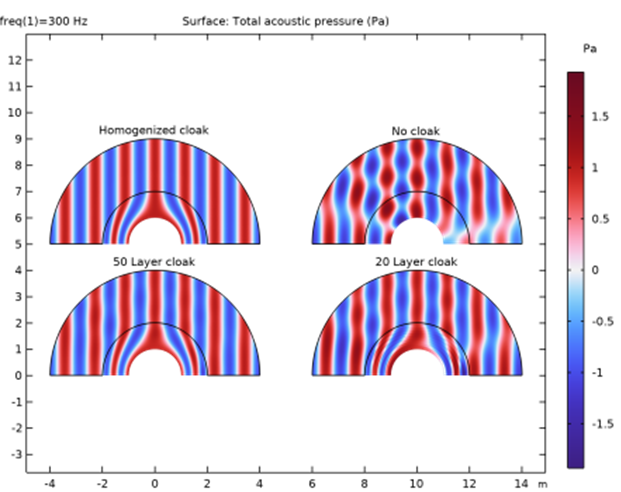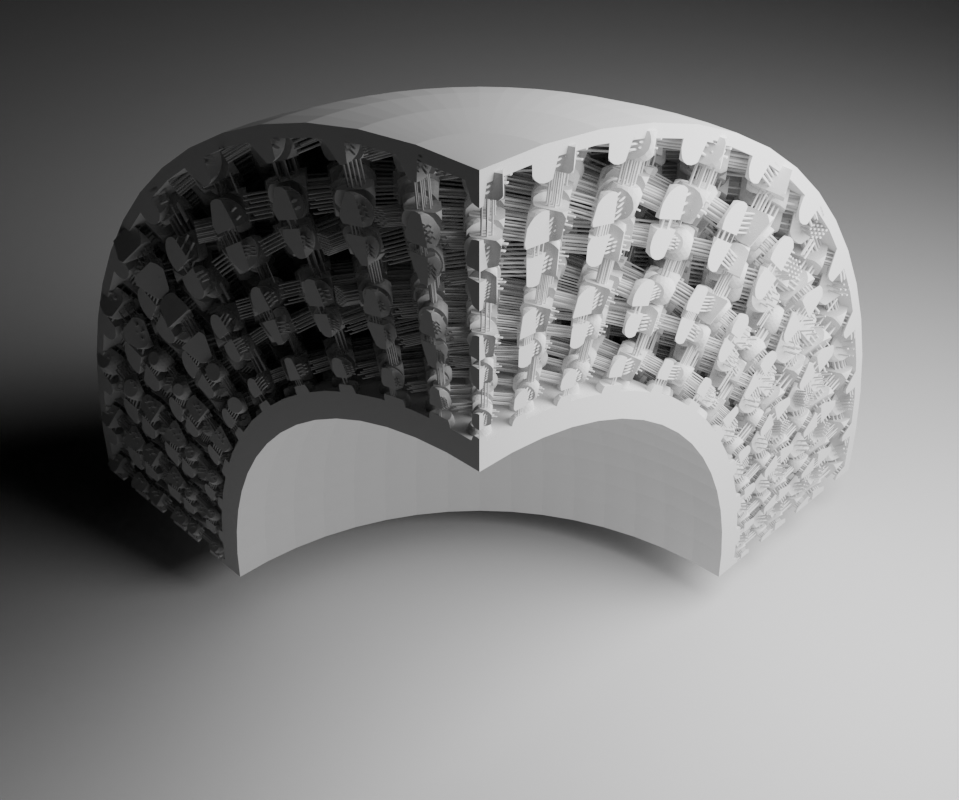
Acoustic invisibility—guiding sound waves around an object so that it becomes effectively undetectable—has rapidly emerged as a fascinating frontier in engineered materials. Among the most promising solutions are pentamode metamaterials, artificial lattice structures designed to control wave propagation with remarkable precision. In numerical studies, however, these materials are typically approximated through homogenized models, where complex microstructures are replaced by equivalent continuous media to significantly reduce computational cost.
While efficient, this simplification comes at a price: it neglects crucial real-world features such as lattice distortions, cell-size variability, and manufacturing imperfections. These effects can substantially alter the acoustic response of the cloak, potentially leading to discrepancies between simulated and actual performance. As a result, there is a clear need for modeling approaches that better capture the true behavior of these systems without becoming computationally prohibitive.
This thesis aims to bridge this gap by developing an enhanced numerical framework that incorporates microstructural imperfections while remaining computationally tractable. The proposed approach will leverage reduced-order modeling techniques to retain the essential physics of the system without explicitly resolving every geometric detail. If time permits, the study could be extended to include an experimental validation of the numerical predictions, providing a tangible assessment of the model’s reliability. The ultimate goal is to deliver a more realistic and practical simulation tool for the design of acoustic cloaking devices based on advanced metamaterials.
Contacts: Marco Verbicaro, Giacomo Brambilla, Jacopo Marconi, Gabriele Cazzulani