
-
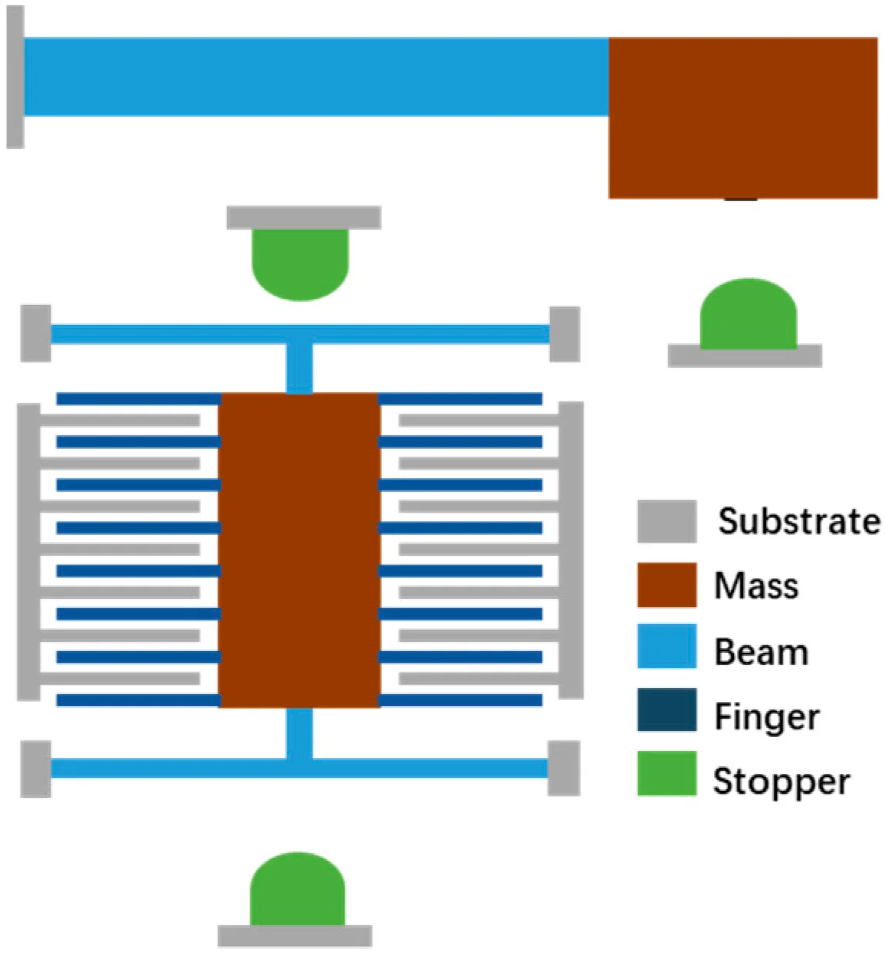
Mechanical nonlinearities (Geometric or Contact) in inertial MEMS sensors
Mechanical nonlinearities play an important role in inertial MEMS sensors and cannot be avoided. The trend to push the performance to the limits caused second-order nonlinear effects to become a critical phenomenon that must be considered: these effects are already visible and characterized on mass production devices. External shocks and vibrations could also induce other type of non-linearities coming from dynamics of contact, adhesion and chipping. FEA software can be used to solve nonlinear dynamics, but a simplified modelling is more convenient when complex structures and simulations are performed. The proposed work will start from experimental results and advanced measurements… Read more
-
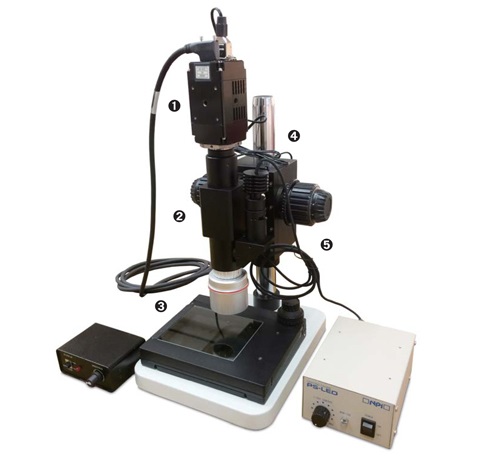
Out-of-plane stroboscopic analysis of MEMS motion sensors
Goal: implement a system for optical stroboscopic analysis of TDK’s MEMS accelerometers and gyroscopes, aimed at the characterization of out-of-plane resonant modes in those devices Strategy: enhance TDK’s existing system for in-plane stroboscopic optical analysis, based on the usage of infrared microscope and synchronously controlled light source, to add the out-of-plane capability. Work phases Estimated project duration: 6 months. Monthly reimbursement provided How to apply Send us an email (Subject: POLIMI-TDK Thesis) directly attaching you CV on: Deadline: 31st January 2026 For more info on the company and other opportunities please visit: Read more
-
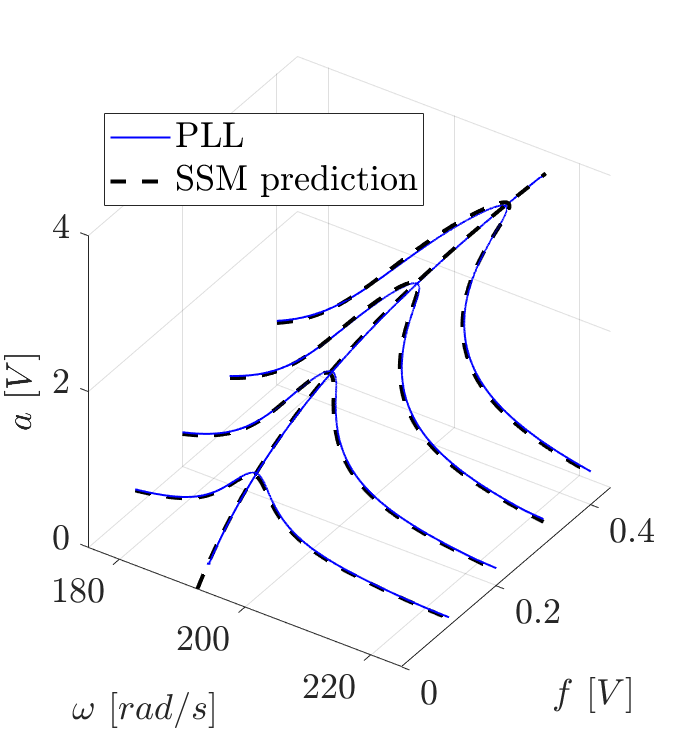
SSM-enhanced Control-Based Continuation (CBC)
In this project we aim to experimentally determine the backbone and the frequency response of a system using Control Based Continuation. CBC consists, loosely speaking, in creating a phase controller (PLL, Phase-Locked Loop) to lock a system at resonance (90°) and then extract the backbone by increasing the forcing with continuation algorithms, typical of numerical analysis. Recently, techniques to compute an SSM from inexpensive experimental tests have emerged. These data-driven SSMs are extremely interesting from the application point of view, as they rely on the real system and because they do not suffer from the inherent limitations of the numerical… Read more
-
Contact dynamics in inertial MEMS sensors
Nowadays, mechanical robustness is a key spec for inertial MEMS sensors. The contacts occurring in silicon structures are a relevant problem that may generate dangerous particles or even cause the breakage of the MEMS sensor. Despite these critical phenomena impacting the sensor’s manufacturing and lifetime functionality, the modeling approaches currently adopted are too simplified. The thesis uses cutting-edge contact dynamics theory to describe the contacts in micromachined silicon structures, focusing on friction and potential chipping. The simulation results will be compared with experimental observations on dedicated MEMS structures, with the final goal of improving failure predictability. The thesis will be… Read more
-
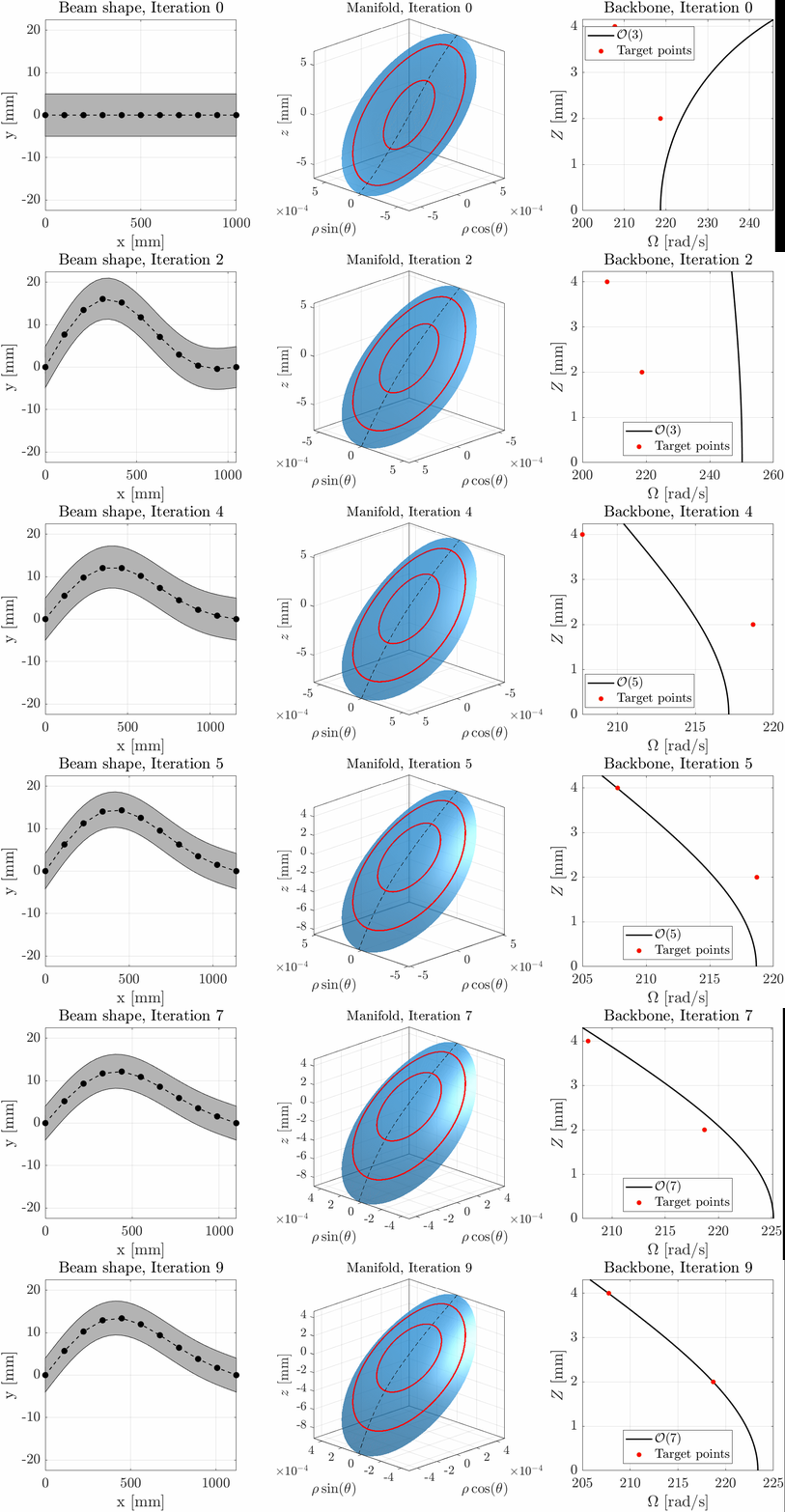
Adjoint formulation for backbone curve computation at arbitrary order
We have recently proposed a method to tailor the nonlinear response of a structure using Spectral Submanifolds (SSM, or Lyapunov Subcenter Manifolds – LSM) and an optimization procedure1. By defining a set of frequency-amplitude pairs we can fit the backbone curve of the system to these points. The computation of the sensitivities of the LSM, required for the optimization procedure, is still very cumbersome and computationally demanding, reason why this approach is still limited to low-dimensional models with a low number of parameters. To remove this constraint, the adjoint method can be used to compute the sensitivity with respect to… Read more