
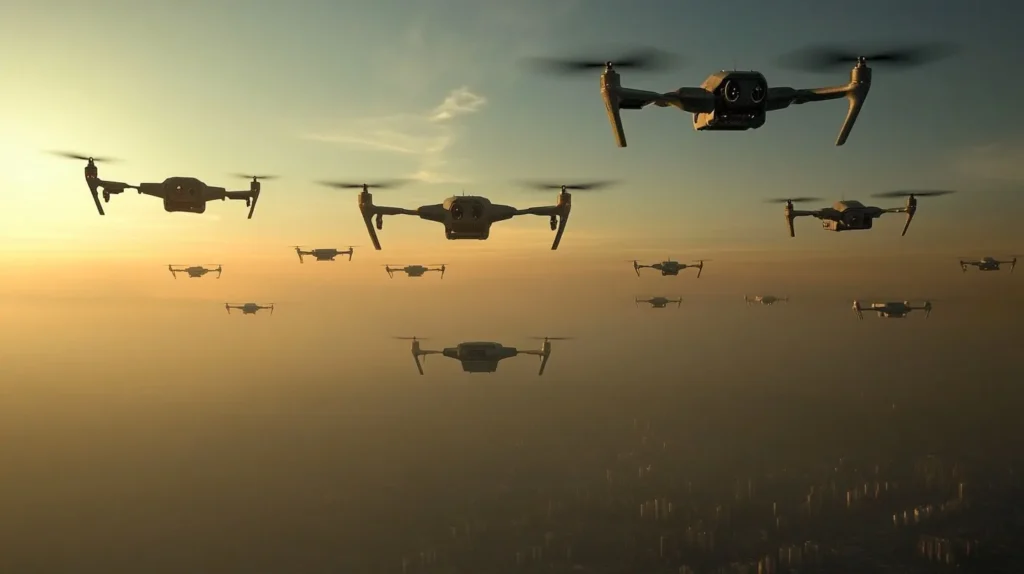
The rapid growth of autonomous aerial systems is driving the development of drone swarms capable of performing cooperative missions such as environmental monitoring, infrastructure inspection, search and rescue, and parcel delivery. As these applications increasingly rely on multiple drones operating in close proximity, aerodynamic interactions between their rotor wakes become an important factor affecting flight efficiency, stability, energy consumption, and control performance.
Current approaches for the simulation and control of drone formations typically neglect these aerodynamic interactions or represent them using highly simplified models. On the other hand, high-fidelity Computational Fluid Dynamics (CFD) simulations are too computationally expensive to support the design, optimization, and real-time control of large drone formations.
The objective of this thesis is to investigate the aerodynamic interactions between multirotor drones flying in formation using physics-based free-vortex wake methods. The work will employ an established aerodynamic solver to simulate the wake generated by individual rotors and its interaction with neighboring drones under different flight configurations. Based on these simulations, the thesis will develop a control-oriented aerodynamic model capable of predicting the influence of wake interactions on rotor thrust and power while maintaining computational efficiency.
The final MATLAB implementation will enable rapid simulation of drone formations and provide a foundation for future research on formation optimization, cooperative flight, and aerodynamic-aware control strategies for autonomous aerial systems.
Required background: basic knowledge of aerodynamics, basic MATLAB programming skills.
Contact: alessandro.fontanella@polimi.it