
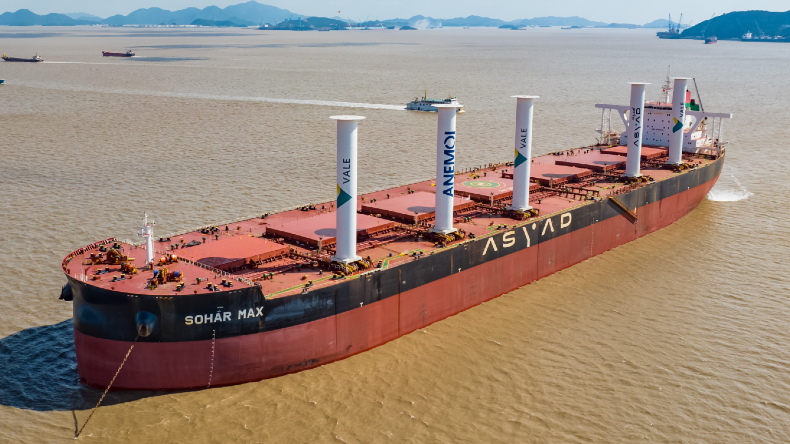
The maritime industry is increasingly adopting innovative technologies to reduce greenhouse gas emissions and improve the energy efficiency of commercial vessels. Among the most promising solutions is Wind-Assisted Ship Propulsion (WASP), with Flettner rotors (rotor sails) emerging as one of the leading technologies for harnessing wind energy to support ship propulsion.
Rotor sails generate aerodynamic lift through the Magnus effect, providing additional thrust and reducing the vessel’s fuel consumption. To maximize these benefits, it is essential to accurately predict the aerodynamic forces acting on the rotors and the flow field they generate. This challenge becomes particularly important when multiple rotor sails are installed on the same vessel, as their aerodynamic interaction can significantly influence overall performance.
The objective of this thesis is to develop a computationally efficient aerodynamic model capable of predicting both the aerodynamic forces and the surrounding flow field of rotor sails. The model will combine aerodynamic coefficients obtained from wind tunnel experiments with simplified flow-field formulations to achieve fast execution times while maintaining sufficient accuracy.
The resulting MATLAB implementation will enable rapid evaluation of different multi-rotor configurations under varying wind conditions, ship speeds, and rotor operating parameters. The tool will support the analysis and optimization of rotor positioning and control strategies for wind-assisted ships.
Required background: basic knowledge of aerodynamics, basic MATLAB programming skills.
Contact: alessandro.fontanella@polimi.it