
-
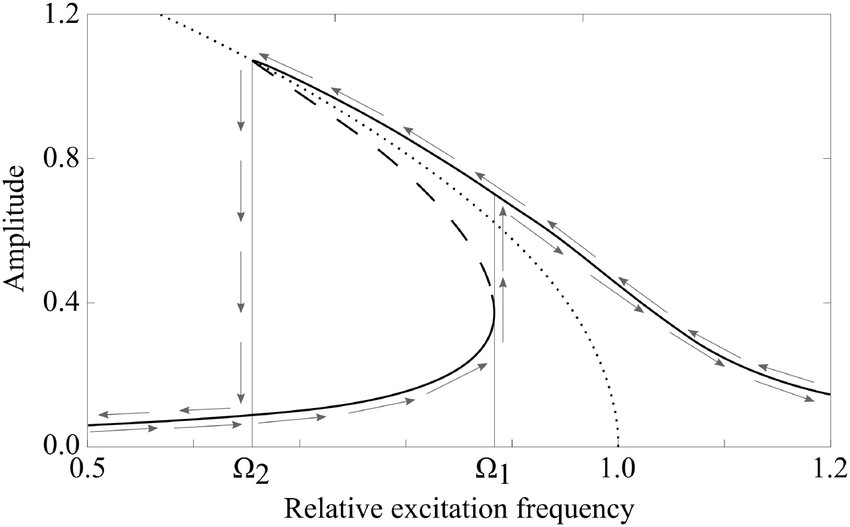
Experimental characterization of nonlinear motion of MEMS resonators
Mechanical nonlinearities play an important role in inertial MEMS sensors, in particular due to geometrical and process constraints. The trend to push the performance to the limits caused second-order nonlinear effects to become a critical phenomenon that must be taken into account: these effects are already visible and characterized on mass production devices. Several methods and models able to describe these nonlinearities are already available in literature and in commercial software; anyway, experimental measurements and validation of these methods are fundamental for the MEMS design activities. The proposed work will focus on the experimental analysis of the dynamics of MEMS… Read more
-
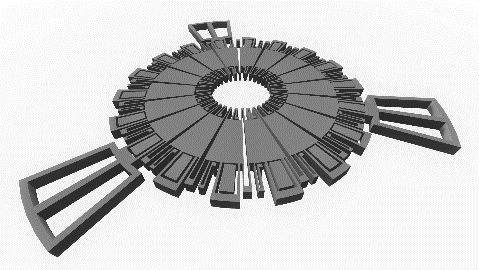
Design of a metamaterial for a novel MEMS mechanical circulator
Several works in literature and from our research group have shown that periodic structures with space-time varying properties lead to a non-symmetric (non-reciprocal) response. In short, in some frequency intervals (band gaps), these metamaterials allow the propagation of waves only in one direction and block them in the opposite direction. This thesis aims to design a novel MEMS circular repetition of cells to obtain a circulator, i.e., a three-port device that receives an input from port 1, transmits it to port 2, and finally to port 3, strictly in this order. A conceptual layout, which adapts a linear array we… Read more
-
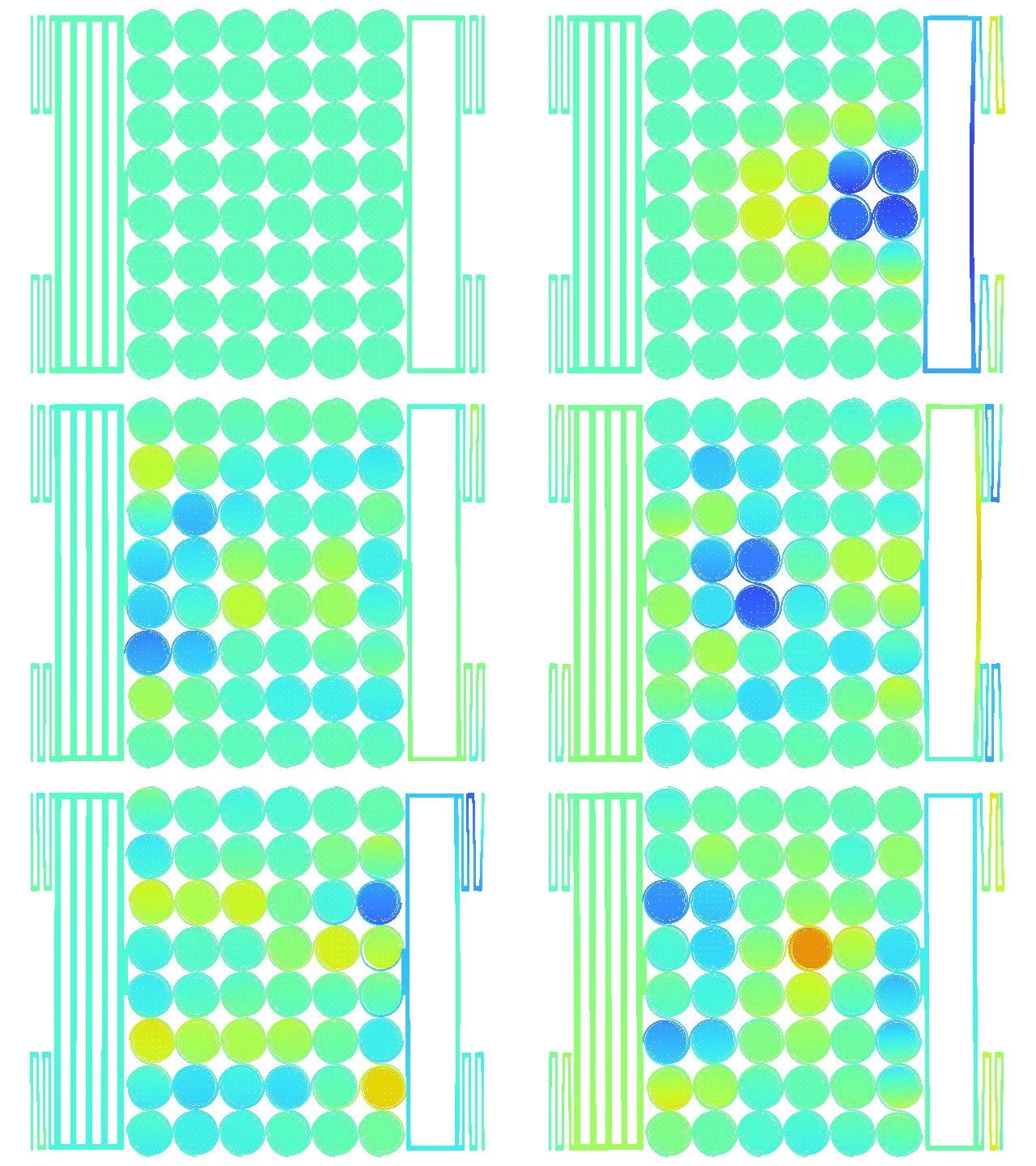
Active & passive meta-MEMS devices for signal processing
During this thesis, the student will design a multifunctional metastructure at the micro-scale, where a tailored arrangement of unit cells allows performing certain operations to an incoming elastic signal. Examples that we want to explore are (i) performing derivative/integrals and arbitrary transfer functions, (ii) frequency conversion, (iii) Wave-diode effect (nonreciprocity), (iv) waveguiding, trapping and focusing. Both experimental and theoretical aspects will be explored. This thesis is done in collaboration with STMicroelectronics. Read more
-
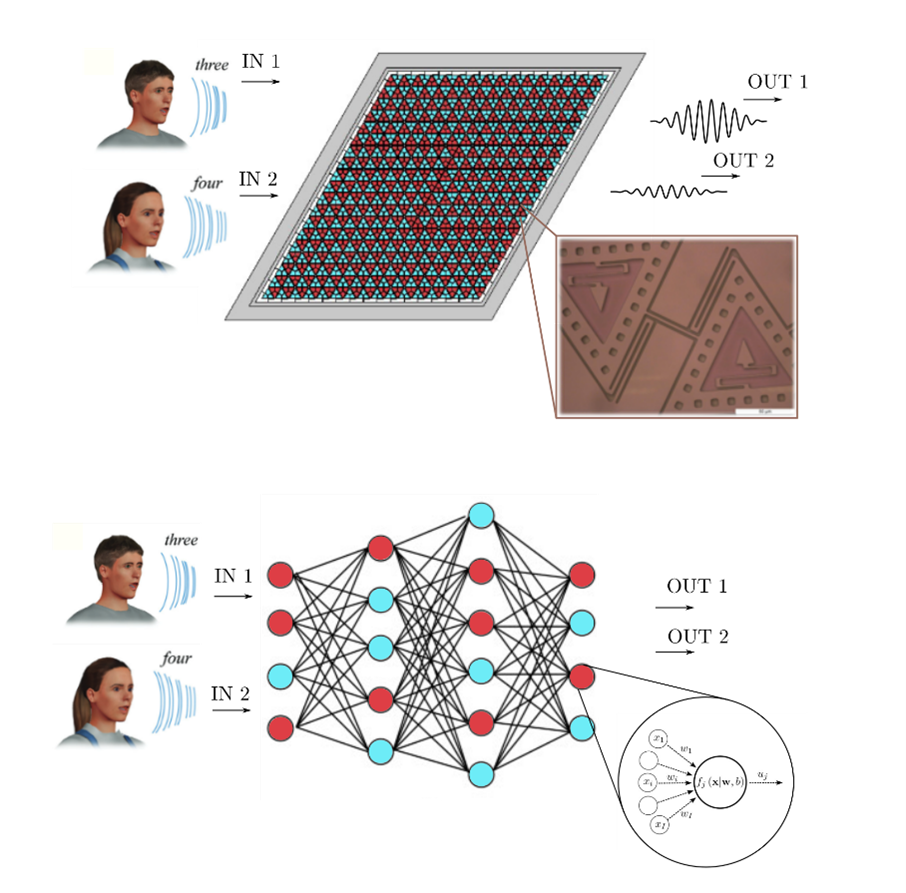
Substructuring techniques and pROMs for the optimization of a MEMS voice recognition device
This thesis aims to develop strategies to alleviate the computational burden of optimising a novel, purely mechanical voice recognition device. The device is composed of many repeated cells, each slightly varied through parametric optimisation of a high-fidelity finite element model with millions of degrees of freedom. Direct simulation of such models is computationally prohibitive, making model reduction essential. Researchers have already explored component mode synthesis techniques to accelerate simulations, but these methods are generally restricted to linear dynamics and yield only modest speedup factors. Such limitations are critical in this context, as the variability and potential nonlinear behaviour of the… Read more
-
Design of MEMS structure for adhesion characterization
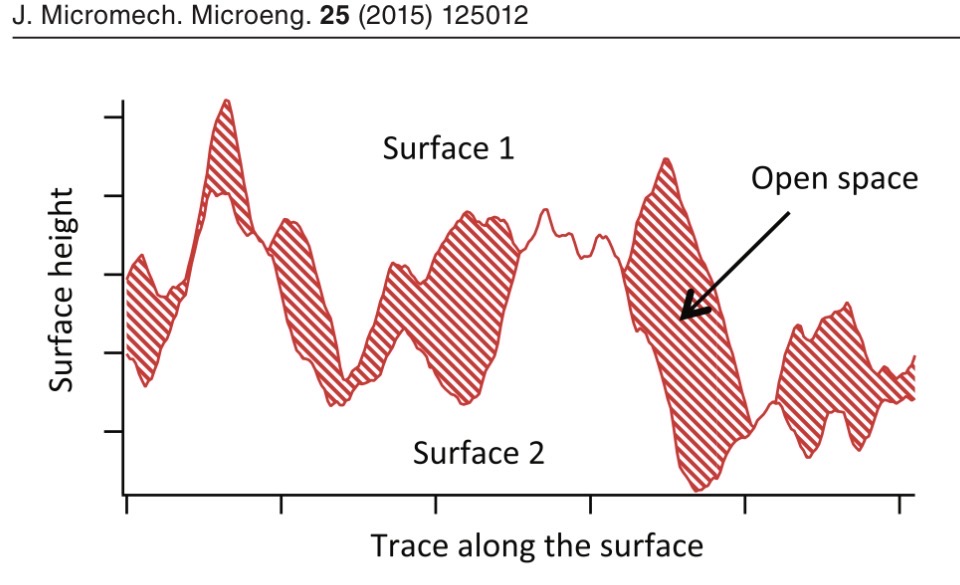
Stiction is a critical phenomenon in MEMS structure which consists in the movable MEMS structure being unable to release from fixed structure when engaged. Stiction depends on many physical mechanisms but can be simplified to a negative balance between restoring forces which try to unstuck the movable mass and the adhesion forces which keep the mass stuck into the fixed surface. At a first order, the adhesion force could be thought as a global parameter that is independent from design choices and could be characterized independently. The goal of the master thesis would be to design simple structures that are… Read more
-
Optimization of systems with Internal Resonances
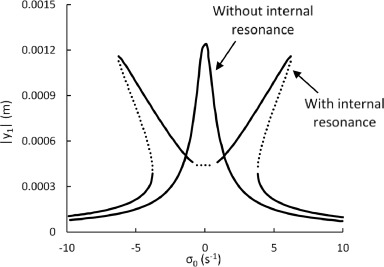
MEMS design is usually done following linear vibration theory, however, their real behavior often turns out to be nonlinear. To address this issue, our group developed optimization algorithms to target backbone curves, which are striclty connected to the nonlinearity of the vibration modes. As of now, the backbone computation can target only a single mode. The aim of this thesis is to extend the analysis to multiple modes, and in particular to the case where they interact through so called internal resonances. These are a special type of resonances occuring when two (“nonlinear”) eigenfrequencies are multiples of each other (e.g., 1:2,… Read more
-
Level-set robust topological optimization applied to MEMS accelerometers
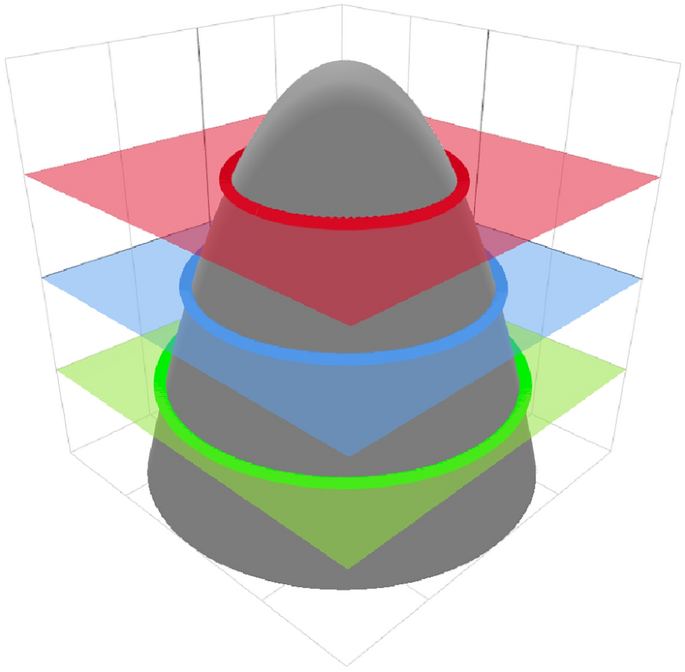
MEMS technology is becoming increasingly important for several inertial applications (e.g., gyroscopes and accelerometers devices). The objective of this thesis is to improve the layout of an existing MEMS accelerometer by implementing level-set topology optimization algorithms in existing software written in C++. Robust techniques will be implemented as well in order to minimize the influence of real-world uncertainties (e.g., manufacturing errors and temperature conditions). This thesis will be carried out in Bovisa campus in collaboration with STMicroelectronics. Tools OpenLSTO (a code for TO in C++), Matlab (YetAnotherFEcode). References Pozzi, M., Bonaccorsi, G., Kim, H.A. et al. Robust structural optimization in presence of… Read more
-
feMEMS: parametric optimization using semi-lumped parameter models
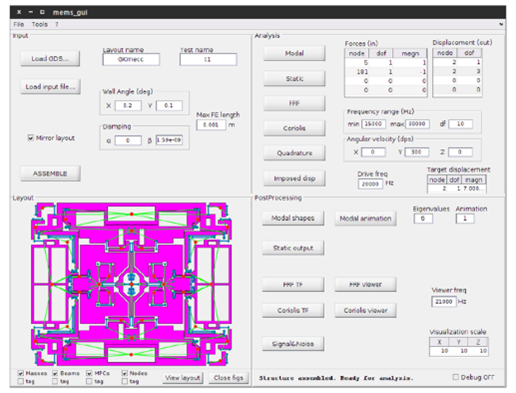
The design of MEMS devices usually involves several Finite Element (FE) analyses, each with different parameters (e.g. beam thicknesses) to tune the characteristics of the sensor. This trial-and-error procedure is tedious and time-consuming, even more so considering that typical FE models may count 100k-1M degrees of freedom. For this reason, our group developed a Matlab code, feMEMS (see the old GUI on the left), to model gyroscopes with beam elements and lumped masses, which has been successfully used for parametric optimization (average iteration time: 0.5s). In this thesis, the candidate will have to reorganize feMEMS using an object-oriented framework to… Read more
-
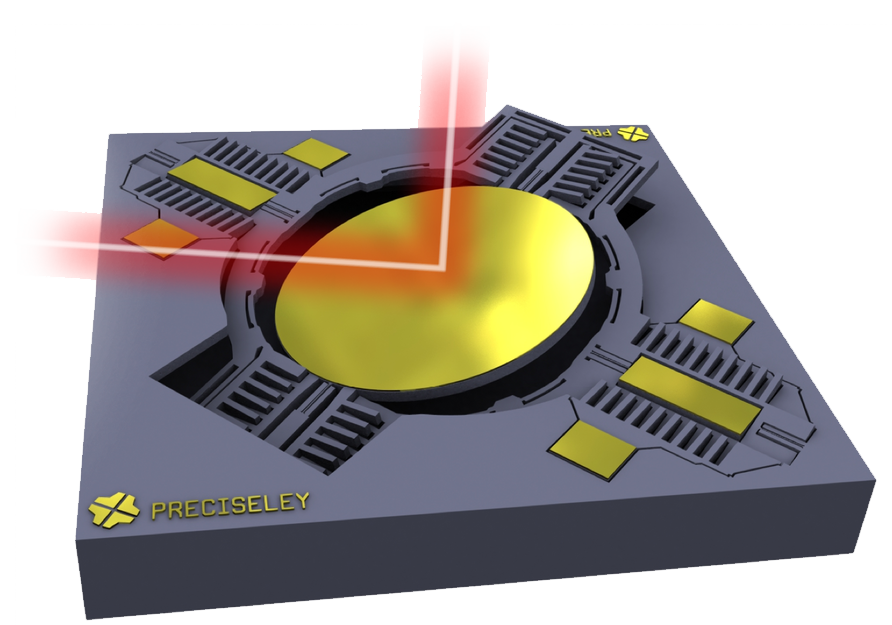
ROM for large rotations in a MEMS micromirror
MEMS micromirrors are micro components used to deflect light rays in many applications, such as to build projectors. Mainly due to their large rotations, these devices exhibit a nonlinear behavior that challenges the construction of traditional nonlinear Reduced Order Models. In this thesis, the candidate will investigate the subject of large rotations (moving on from some preliminary results we obtained) and propose solutions (e.g. sub-structuring with Rubin’s method). Read more
-
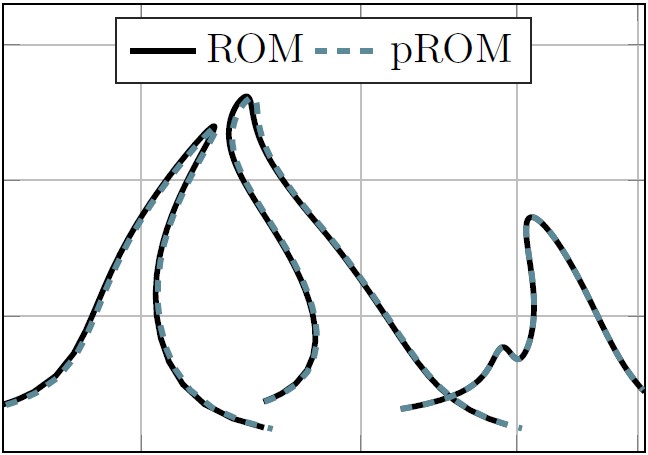
Parameter continuation of SSM for parametrized defects
In this project we aim to develop an analytic formulation for Spectral Submanifolds (SSMs) depending on a parameter. In particular, the focus is on a formulation for shape defects previously studied in Marconi et al., where a different MOR strategy was used. Indeed, the problem of shape defects is very important in the MEMS field industry, as defects have a deep impact on the performances of sensors, both at linear and nonlinear level. A shape-parametric SSM would help in the statistic prediction of the sensor performances and their sensibility to defects. Tools SSMTool, YetAnotherFEcode References Marconi, J., Tiso, P., Quadrelli, D.E. et… Read more
-
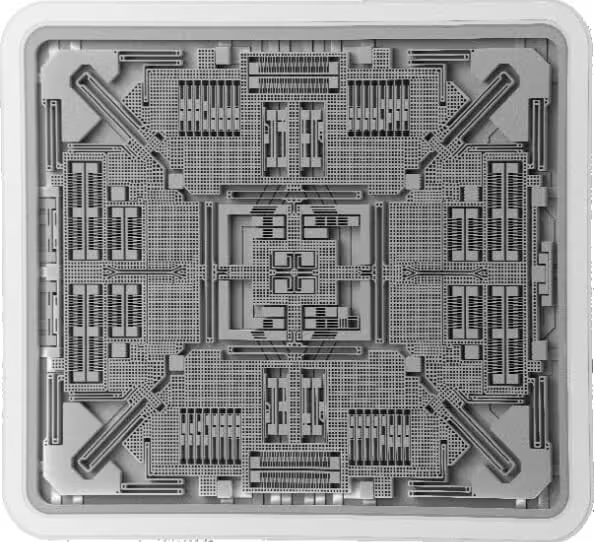
Design of a small-footprint MEMS gyroscope
MEMS gyroscopes are micro sensors for angular rate, which can be found in almost any electric device, from smartphones to drones, cars, and robots. The trend of the industry nowadays is to go for ever smaller footprint sensors so that they can be embedded in a smaller system, absorb less energy, and last (but not least), more devices can be produced per unit area of the silicon wafer, thus increasing the revenues. This thesis aims to study a miniaturized version of pre-existing gyroscope layouts, considering nonlinear effects using state-of-the-art methods and (possibly) including multi-physics effects (e.g. electrostatics). Depending on the… Read more