
MEMS design is usually done following linear vibration theory, however, their real behavior often turns out to be nonlinear. To address this issue, our group developed optimization algorithms to target backbone curves, which are striclty connected to the nonlinearity of the vibration modes. As of now, the backbone computation can target only a single mode.
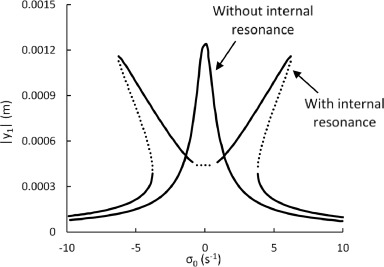
The aim of this thesis is to extend the analysis to multiple modes, and in particular to the case where they interact through so called internal resonances. These are a special type of resonances occuring when two (“nonlinear”) eigenfrequencies are multiples of each other (e.g., 1:2, 1:3). Internal resonances are particularly difficult to predict and may often lead to unwanted behavior of the system. In MEMS gyroscopes, for instance, the resonance may “fool” the drive control loop and make the device resonate at a wrong frequency and amplitude. The objective of this work is to control the modal coupling governing the internal resonances, either to avoid or to exploit them.
Tools
References
Li, M., Jain, S. & Haller, G. Nonlinear analysis of forced mechanical systemswith internal resonance using spectral submanifolds, Part I: Periodic response and forced response curve. Nonlinear Dyn 110, 1005–1043 (2022). https://doi.org/10.1007/s11071-022-07714-x