
Drive-by approaches aim to assess bridge structural health status exploiting on-board train measurements. Precisely, damage occurrence on the bridge can be reflected in the dynamic interaction between the train and the bridge itself, and thus in the train response. The focus of this thesis is to improve previously developed signal processing procedures to develop and implement novel and effective algorithms for bridge health status evaluation, damage detection and localization.
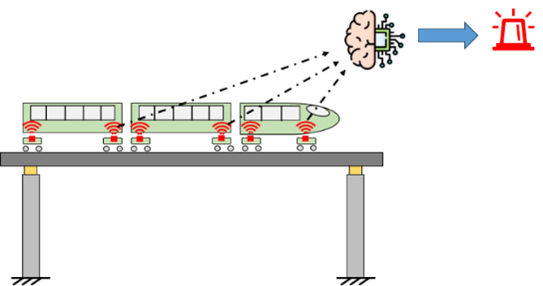
During the thesis the student will use an established time domain simulation tool for train-track-bridge interaction (ADTreS) dynamic simulation, developed and continuously upgraded inside the Department of Mechanical Engineering. The thesis work should tackle influencing factors affecting the potential performances of drive-by methods when applied to real-life scenarios, such as the influence of track irregularity and the variability of operational factors, such as train mass and speed. The work will support the scientific advancement of these methodologies, with the aim of promoting their systematic use in real-world scenarios.
Contacts: Lorenzo Bernardini, Andrea Collina