
DETAILS: the aim of this project is to study a metamaterial structure capable of focusing ultrasound from outside to the inside the skull. In this field, the state-of-the-art ultrasound technology features a hemispherical transducer array with many piezoelectric elements operating around a central frequency of 650 kHz. By leveraging complex electronic circuits the system allows delivering tailored amplitudes and phases to each transducer, focusing sound from outside to inside the skull into a spatial region as small as a wavelength. However, skull-induced aberrations reduce the maximum pressure, shift the pressure peak, broaden the main lobe, and increase sidelobe effects.
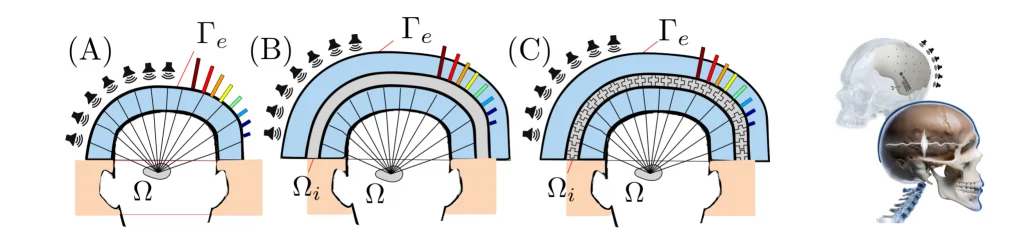
These undesired effects make the focusing process very sensitive to variations and, hence, unique for each patient. There are multiple goals (and hence multiple theses) on this project:
- Study a metamaterial that is capable of controlling the Leaky wave radiation. Leaky waves are a special type of waves that form at an interface between a fluid (brain matter or water) and a solid (the skull). These waves are responsible for part of the aforementioned aberration mechanism, and hence, undesirable. However, it has been discovered that, if controlled, the leaky wave radiation allows for a more efficient energy transfer from outside to insde the skull. The idea of this thesis is to leverage this leaky wave radiation and, thanks to a biocompatible metastructure bonded on the skull, reedirect and them at will, thereby achieving the desired focusing performance. This can be accomplished through space- or time-modulated materials, where the space- or time-modulation parameters are the control action capable of controlling the radiation angle and intensity of leaky waves.
- Study a helmet-like metamaterial device that is capable of compensating the aberration caused by the skull. This metamaterial device is meant to operate at the source and in a robust manner, independently of the geometry of the skull, thereby making the focusing strategy applicable to different patients. The metastructure de facto replaces the phase-delay implementation based on complex electronic circuits and, in contrast to conventional aberration compensation strategies, the phasing will be accomplished trough dynamic optimization, where a cost function weights the pressure level in the focusing area, and the dynamic constraint accounts for the underlying structural dynamics (and average aberrations) of the skull.
Contacts: Emanuele Riva