
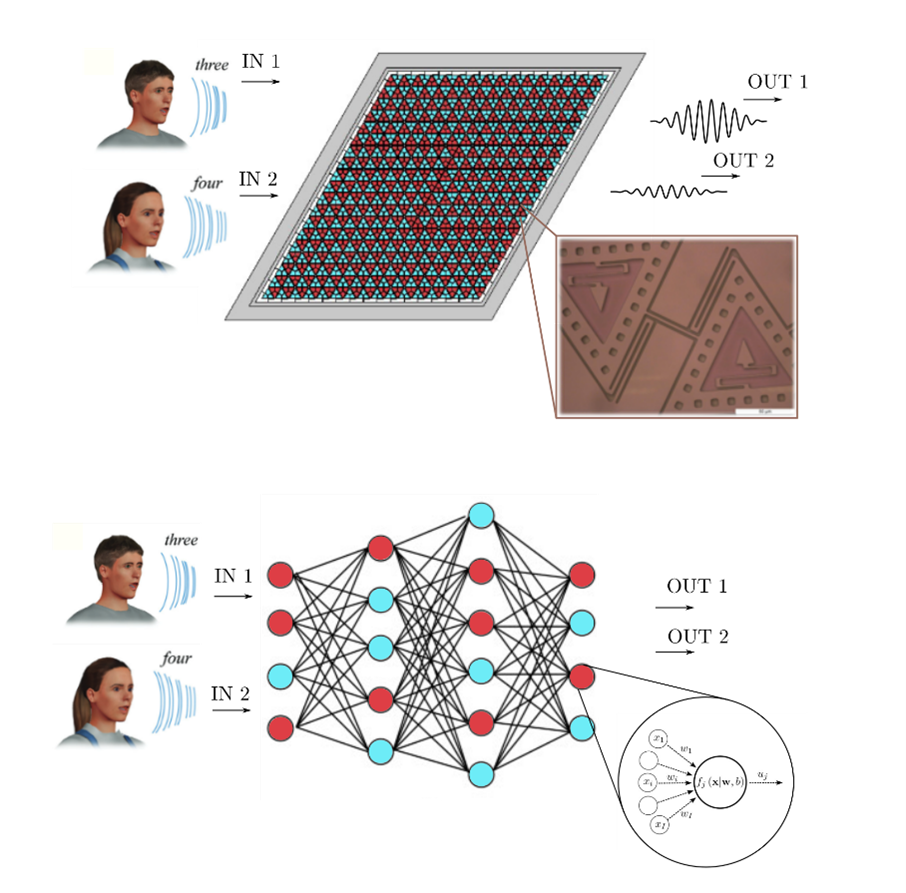
This thesis aims to develop strategies to alleviate the computational burden of optimising a novel, purely mechanical voice recognition device. The device is composed of many repeated cells, each slightly varied through parametric optimisation of a high-fidelity finite element model with millions of degrees of freedom. Direct simulation of such models is computationally prohibitive, making model reduction essential.
Researchers have already explored component mode synthesis techniques to accelerate simulations, but these methods are generally restricted to linear dynamics and yield only modest speedup factors. Such limitations are critical in this context, as the variability and potential nonlinear behaviour of the device’s cells require more advanced approaches.
The candidate will therefore investigate substructuring strategies and parametric reduced-order models (pROMs), with the aim of constructing a single efficient reduced model for each cell that can capture parameter dependence while preserving accuracy. The work will not only apply but also adapt and extend existing methods to address the unique demands of this system. An attractive starting point is the pROM framework described in [1], which provides efficient interpolation of reduced models across parameter variations.
Tools
References
[1] Marconi, J., Tiso, P., Quadrelli, D.E. et al. A higher-order parametric nonlinear reduced-order model for imperfect structures using Neumann expansion. Nonlinear Dyn 104, 3039–3063 (2021). https://doi.org/10.1007/s11071-021-06496-y