
Leaky waves exist in correspondence of a boundary between a fluid, when the velocity of the wave propagating in the solid is greater than that propagating in the fluid. As a result, there is a radiation mechanism that takes place, whereby the energy, initially sitting in the solid, propagate in the fluid at a fixed angle. At the micro-scale, this phenomenon is employed to drive small liquid droplets (see the figure on the left). The aim of this thesis is to develop metasurfaces capable of controlling the radiation angle and intensity. These radiation attributes, in turn, allows controlling the velocity (in 1D configurations) and the directionality (in 2D configurations) of the fluid. In other word, the metasurface parameters can be interpreted as a “control action” and the problem reformulated as an optimal control problem, where the target behavior is the motion of the droplet, constrained to the physics of leaky waves and the fluid dynamics.
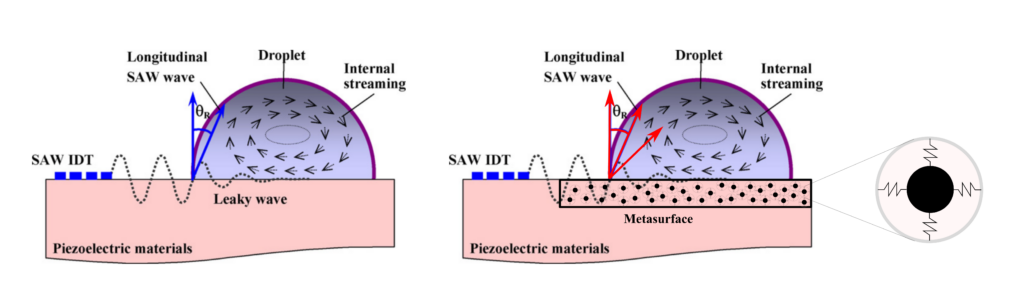
- Fu, Yong Qing, et al. “Recent developments on ZnO films for acoustic wave based bio-sensing and microfluidic applications: a review.” Sensors and Actuators B: Chemical 143.2 (2010): 606-619.