
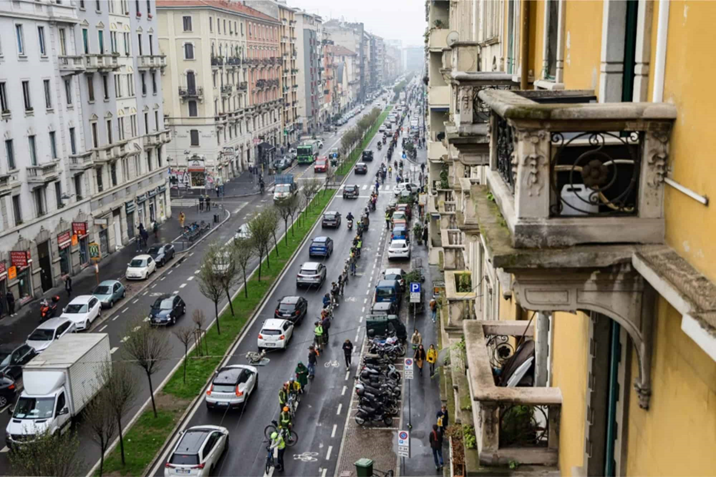
GLOSA (Green Light Optimal Speed Advisory) can significantly improve traffic flow by helping drivers adjust their speed to pass through intersections during green phases, thereby reducing unnecessary stops, delays, and congestion. This results in smoother driving patterns and lower emissions. However, the effectiveness of GLOSA depends on factors such as traffic density and the market penetration of connected and automated vehicles.
The aim of this thesis is to conduct a traffic microsimulation study to evaluate the effectiveness of state-of-the-art GLOSA systems for connected vehicles. The simulations will assess how traffic performance changes when different proportions of vehicles or drivers comply with the speed advice. This will make it possible to investigate the capability of GLOSA to improve traffic efficiency in mixed environments that include both conventional and automated vehicles, as well as under partial or full market penetration of connected and automated vehicles. The work will be carried out using numerical simulations in MATLAB/Simulink and SUMO.
Contacts: Edoardo Sabbioni, Daniele Vignarca, Martina Tornesi, Stefano Arrigoni