
Background and Motivation
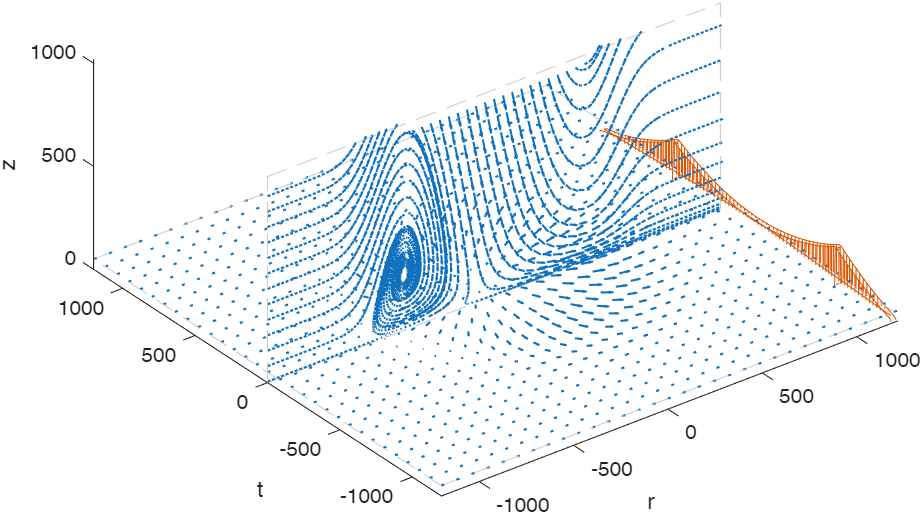
Downbursts are localized, intense downdrafts produced by convective storms that generate strong, transient, and highly non-uniform wind fields near the ground. Unlike synoptic winds, downbursts exhibit rapid temporal variation and complex spatial characteristics, posing a significant challenge to conventional wind engineering assumptions. Slender structures such as transmission towers, chimneys, masts, long-span bridges, and tall buildings are particularly vulnerable due to their flexibility and sensitivity to dynamic wind loads. Current design codes are largely based on stationary, boundary-layer wind models and may not adequately capture the structural response under downburst-type loading. A better understanding of the dynamic interaction between downburst wind fields and slender structures is therefore essential to improve structural safety and resilience.
Objectives
The main objectives of this thesis are:
- To review and characterize the key features of downburst wind fields relevant to structural loading.
- To develop or adopt suitable models for representing downburst-induced wind forces on slender structures.
- To analyze the dynamic response of selected slender structural systems subjected to downburst loading.
- To compare structural responses under downburst winds with those under conventional synoptic wind models.
- To identify critical parameters influencing structural demand, such as downburst intensity, duration, radius, and relative position with respect to the structure.
Methodology
The proposed research will involve:
- A comprehensive literature review on downburst phenomena, wind field modeling, and structural response of slender systems.
- Selection of representative slender structural models, such as cantilever towers, simplified tall building models, or idealized bridge models.
- Implementation of downburst wind velocity and pressure time histories using analytical, numerical, or empirical models.
- Time-domain dynamic analysis using numerical tools (e.g., finite element or simplified multi-degree-of-freedom models).
- Parametric studies to investigate the influence of wind and structural characteristics on dynamic response.
- Interpretation of results with reference to current design practices and code provisions.
Expected Outcomes
The thesis is expected to:
- Provide insight into the dynamic behavior of slender structures under downburst loading.
- Highlight differences between responses induced by downbursts and traditional wind models.
- Identify conditions under which downbursts may govern structural design.
- Offer observations relevant to wind-resistant design of slender structures.
Prerequisites
Basic knowledge of structural dynamics, wind engineering, and numerical analysis is recommended. Familiarity with structural analysis software or programming tools is an advantage.
Contact: prof. Tommaso Argentini (tommaso.argentini@polimi.it)