
Category: MEMS
-

Topology Optimization in nonlinear dynamics
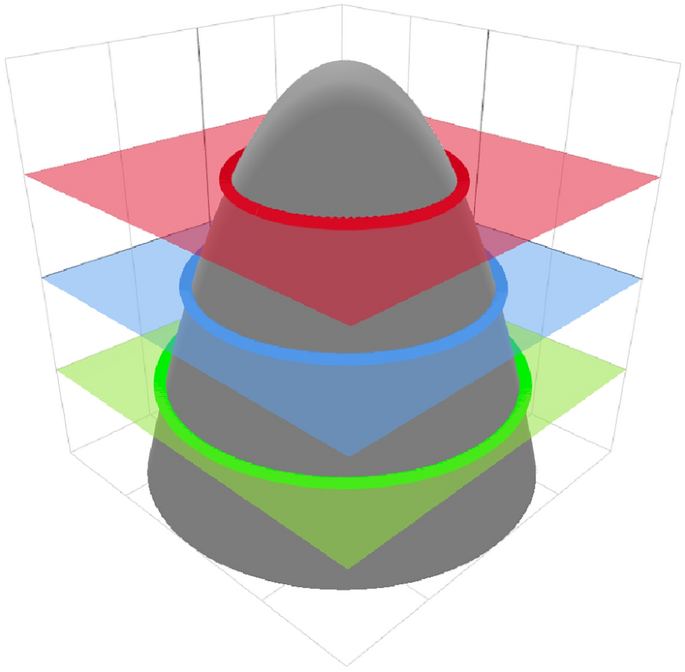
Topology optimization techniques for the design of MEMS devices in a linear dynamics framework have already been studied in several works in the literature. However, since there is no control of the degree of nonlinearity of the structure during the optimization process, the outcome of these routines often departs significantly from linearity. The consequence is
-
Level-set robust topological optimization applied to MEMS accelerometers
MEMS technology is becoming increasingly important for several inertial applications (e.g., gyroscopes and accelerometers devices). The objective of this thesis is to improve the layout of an existing MEMS accelerometer by implementing level-set topology optimization algorithms in existing software written in C++. Robust techniques will be implemented as well in order to minimize the influence
-
feMEMS: parametric optimization using semi-lumped parameter models
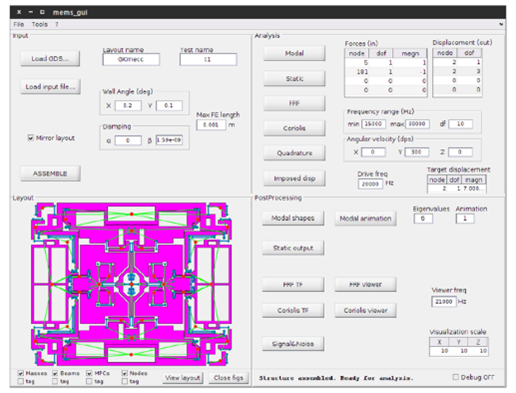
The design of MEMS devices usually involves several Finite Element (FE) analyses, each with different parameters (e.g. beam thicknesses) to tune the characteristics of the sensor. This trial-and-error procedure is tedious and time-consuming, even more so considering that typical FE models may count 100k-1M degrees of freedom. For this reason, our group developed a Matlab
-
ROM for large rotations in a MEMS micromirror
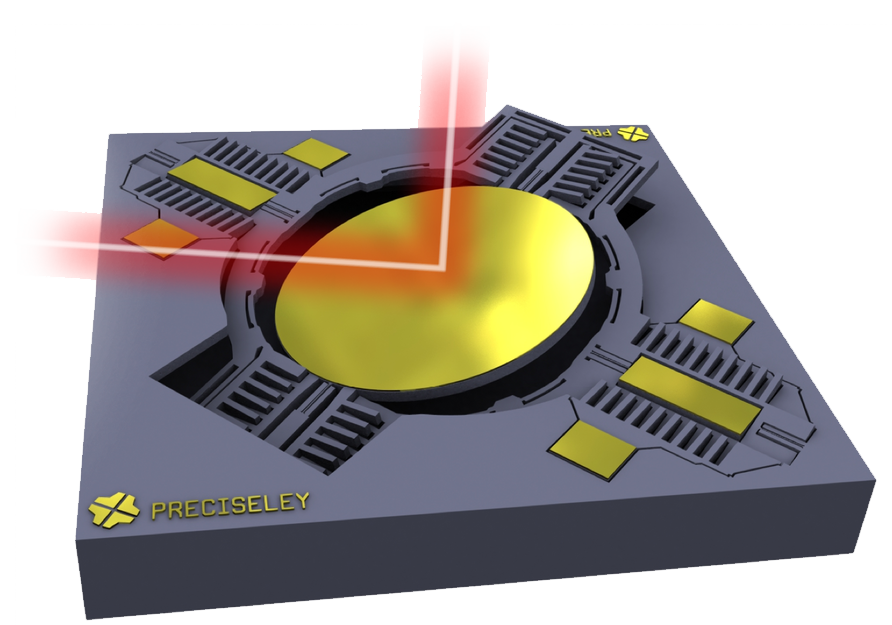
MEMS micromirrors are micro components used to deflect light rays in many applications, such as to build projectors. Mainly due to their large rotations, these devices exhibit a nonlinear behavior that challenges the construction of traditional nonlinear Reduced Order Models. In this thesis, the candidate will investigate the subject of large rotations (moving on from
-
Parameter continuation of SSM for parametrized defects
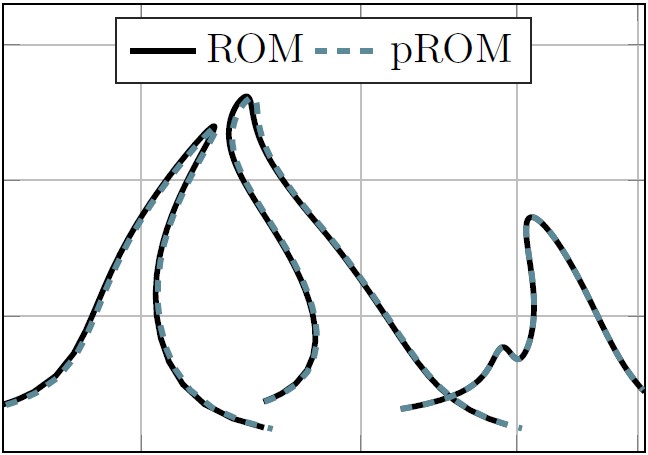
In this project we aim to develop an analytic formulation for Spectral Submanifolds (SSMs) depending on a parameter. In particular, the focus is on a formulation for shape defects previously studied in Marconi et al., where a different MOR strategy was used. Indeed, the problem of shape defects is very important in the MEMS field industry,
-
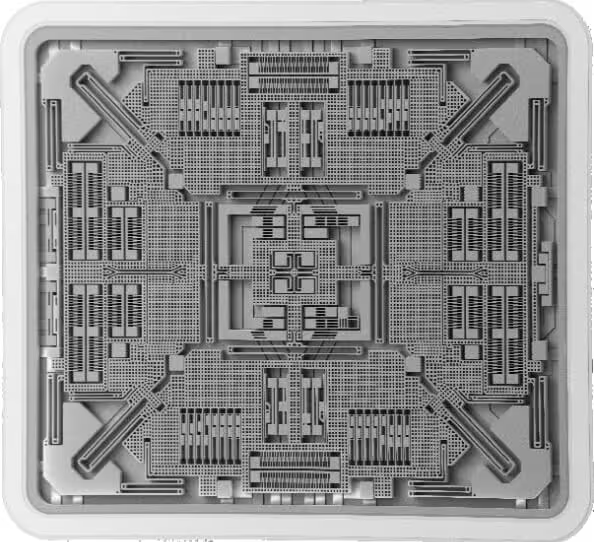
Design of a small-footprint MEMS gyroscope
MEMS gyroscopes are micro sensors for angular rate, which can be found in almost any electric device, from smartphones to drones, cars, and robots. The trend of the industry nowadays is to go for ever smaller footprint sensors so that they can be embedded in a smaller system, absorb less energy, and last (but not
-
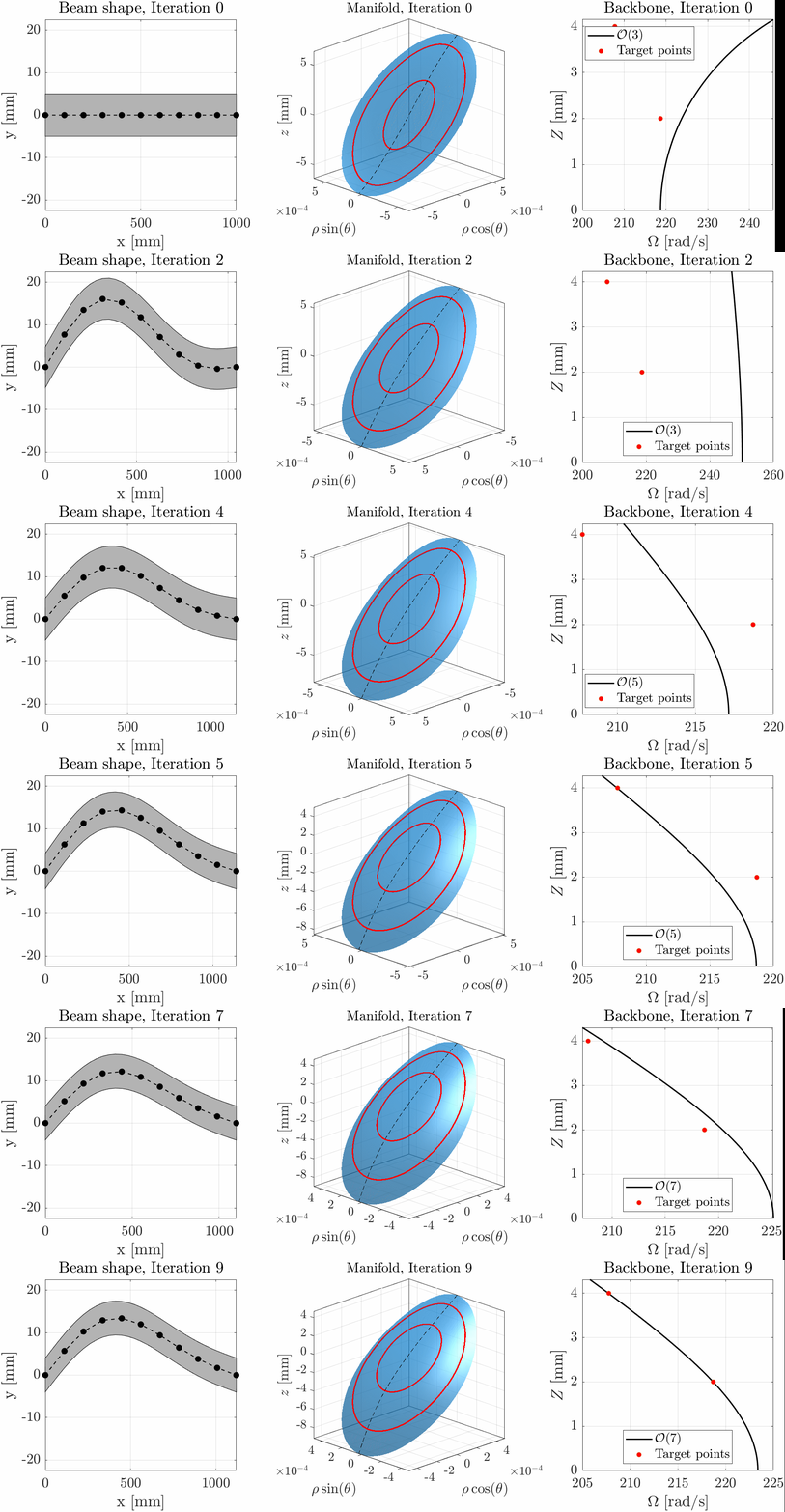
Adjoint formulation for backbone curve computation at arbitrary order
We have recently proposed a method to tailor the nonlinear response of a structure using Spectral Submanifolds (SSM, or Lyapunov Subcenter Manifolds – LSM) and an optimization procedure1. By defining a set of frequency-amplitude pairs we can fit the backbone curve of the system to these points. The computation of the sensitivities of the LSM,