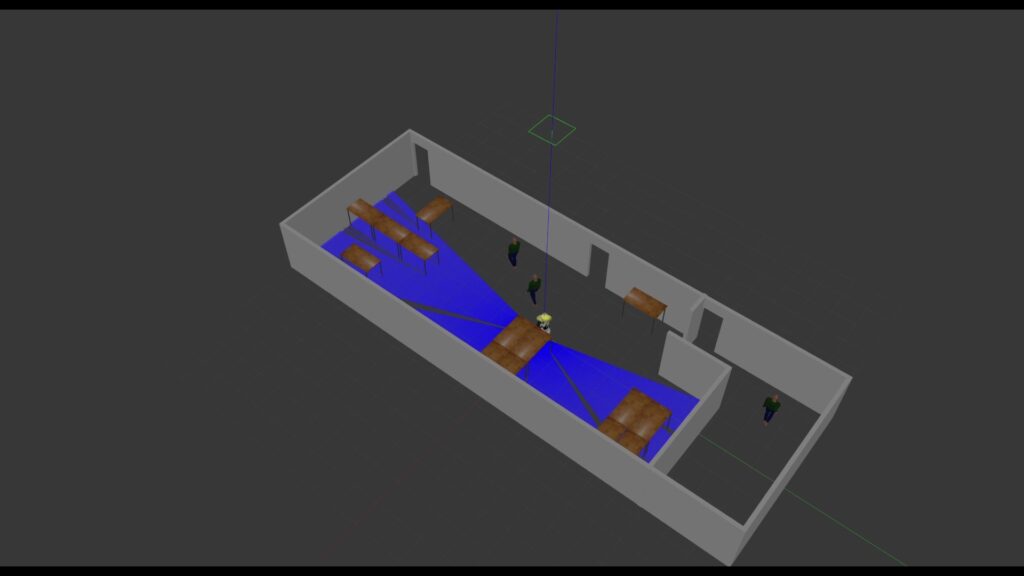
Assistance and monitoring during elders’ daily walk is something that stakeholders expect from an assistive robot. Though cart-like walkers represent a possible solution, they are limited in versatility. Contrarily, a humanoid walking assistant has the potentiality to accomplish many other tasks and to engage in social interactions, extending the caregivers’ activity.
The student will develop and validate sensor-based solutions for robust line-following navigation and user tracking in a (partially) known, dynamic environment. Working with the TIAGo robot (PAL Robotics), the candidate will identify and integrate sensors (e.g., RGB/RGB-D cameras, IR sensor arrays, event cameras…) to enable the robot to move side-by-side with a person along the path, maintaining a safe and consistent relative position. The work will include the design and implementation of computer vision and sensor fusion algorithms, as well as the control to regulate robot motion. The developed system will be tested in a representative scenario, evaluating both quantitative performance metrics and qualitative outcomes related to user experience.
Contacts Luca Pozzi | Marta Gandolla