
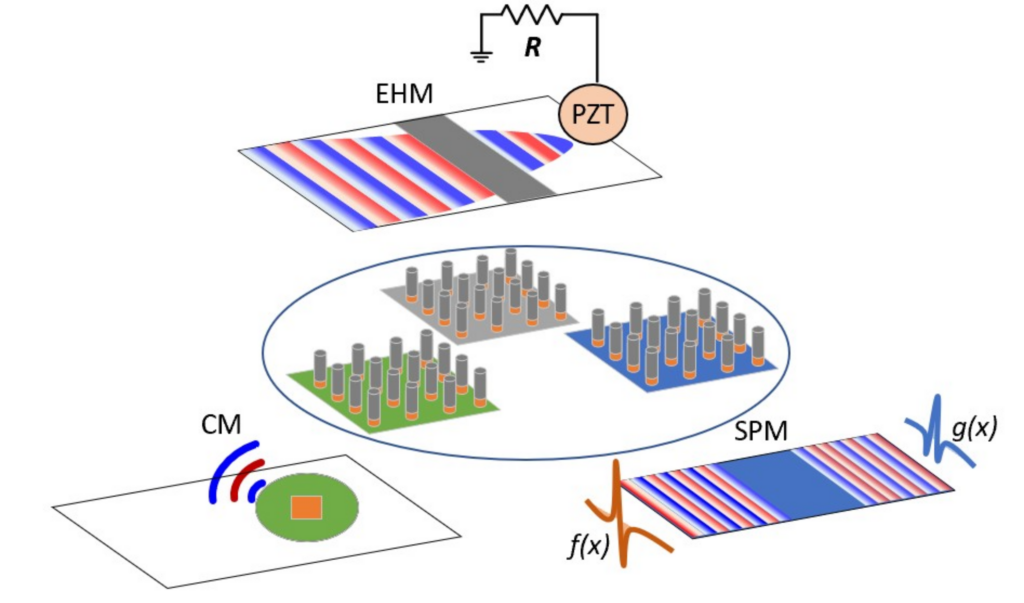
The aim of this thesis is to explore numerically and experimentally the fundamentals of wave elastodynamics in active, nonlinear, and topological metamaterials, and to identify functional behaviors that can be engineered to realize modules with a well-defined functionality. The implementation, then, consists of a network of modular transducers that can be easily embedded in a host structure and with self-powering capabilities. The transducers are meant to either generate an input wavefield or, given an input one, provide an output signal which embodies relevant information regarding static or dynamic structural responses, to be used for structural health monitoring (SHM) and non-destructive testing (NDT). In addition, the meta-transducers are meant to perform analog operations usually accomplished after the acquisition, thereby providing a monitoring solution integrated with the host structure. In particular, we would like the system to pursue analog tasks without the need for additional processing and, hence, to overcome some limitations given by digital processing dictated by analog to digital (A/D) and digital to analog (D/A) conversion and parallel computing, which will be discussed more in detail in the remainder of the proposal. Among all the promising functionalities achievable with this approach, we identify in particular the following three ones, which correspond in our view to three distinct metamaterial-based modules (in figure).
All these thesis projects will be both numerical and experimental.
This research project is in collaboration with the Alma Mater Studiorum – Università di Bologna and funded by the italian “Ministero dell’università e della ricerca” through a “progetto di rilevante interesse nazionale (PRIN)” project.
More information
- The first module, denoted as the energy harvesting module, is meant to efficiently convert the energy of impinging waves into electricity. This energy can be used to feed the other modules and, hence, serves for creating a network of self-powered modular transducers. There are several strategies based on passive metamaterials to improve the efficiency of energy harvesting devices and, therefore, to achieve power levels commensurate to engineering applications. For instance, recent efforts have shown experimental realization of super-lenses, acoustic black holes, and graded configurations that are successfully used for this purpose. However, all these examples have limitations in terms of manufacturing processes and usually operate narrowband. Parametrically amplified materials induced by nonlinear interactions or temporal modulations can be employed to achieve reasonable power output and broader operational frequency ranges. These strategies are known to exhibit frequency conversion either due to coupling between super or sub-harmonics (for nonlinear elements) or due to smooth modulations of the dispersion properties relative to the underlying medium (temporal modulations). Our aim is to exploit these mechanisms to manipulate the input wavefield and, hence, obtain a more advantageous (low frequency) spectrum, which can be effectively employed to design energy sinks with improved harvesting capabilities.
- The second module, denoted as communication module, combines enhanced sensing and wave generation in the form of directional wave propagation. The module is meant for enhancing both the emission as well as the receiving of elastic signals , which are relevant for SHM and NDT where the input and output signals can be correlated to shed light on possible structural changes and, hence, to perform damage detection. The opportunity to redirect waves in space is clearly beneficial for this purpose but, unfortunately, cannot be easily achieved through conventional (non-directional) transducers. In contrast, there is a plethora of wave steering and vibration control mechanisms based on metamaterial configurations, quasi-crystals, or through a periodic segmentation of the transducer that can be employed to manipulate the wavefield. However, linear time-invariant implementations have severe limitations in bandwidth, and the directionality is in general non-reconfigurable. Tunability and digitally controllable propagation directions can be achieved when active or nonlinear metamaterials are considered. In particular, external stimuli (either electrical or mechanical) serve to induce relevant changes in the effective parameters of the underlying medium. In addition to the directionality and tunability, more complex functionalities can be accessed through active and nonlinear interactions, such as nonreciprocal transmission, generation of higher order harmonics, and temporal waveguiding, which can be functional for the generation of waves with asymmetric dispersion and/or with a rich (non-monochromatic) spectral content.
- The third and last module is denoted as processing module, which is intended to perform analog operations between an input and an output port through integrated metasurface able to emulate the input-output relations that are conventionally accomplished via digital processors. For example, recent efforts on the topic have shown implementations of integration ad differentiation in optical and acoustic devices via a fine tuning of dielectric/acoustic slab waveguides based on green’s function techniques, and through tailored dielectric/acoustic metasurfaces. In other words, by shaping the input-output relation via a functional design of the geometry and/or the material parameters, one can manipulate the information carried by the spatial (wavenumber) or temporal (frequency) degrees of freedom of the wave. As compared to digital solutions for signal processing, analog configurations are on one hand less flexible, but on the other hand allow for real-time computation with no additional processing required after the operation. Even simple linear algebra operations via digital computing require analog-to-digital (A/D), and digital-to-analog (D/A) conversion, which are expensive in terms of power required, computational cost and lead to unavoidable time delays, which de facto limits the applicability to relatively low frequency processing. For this reason, and despite relying on more complex architectures and implementations of the physical system, analog computing is currently proposed as a more effective solution to replace digital devices for the developments of big data processing, neural networks (NN), artificial intelligence (AI). Also, the applicability of wave-based analog computing is not merely functional to mathematical operations, but can be employed for the monitoring of structures, where usually post-processing (such as filtering, signal decimation and detrending) is required to polish the measured data and to unveil the presence of defects and changes of dynamical characteristics.