
Background and Motivation
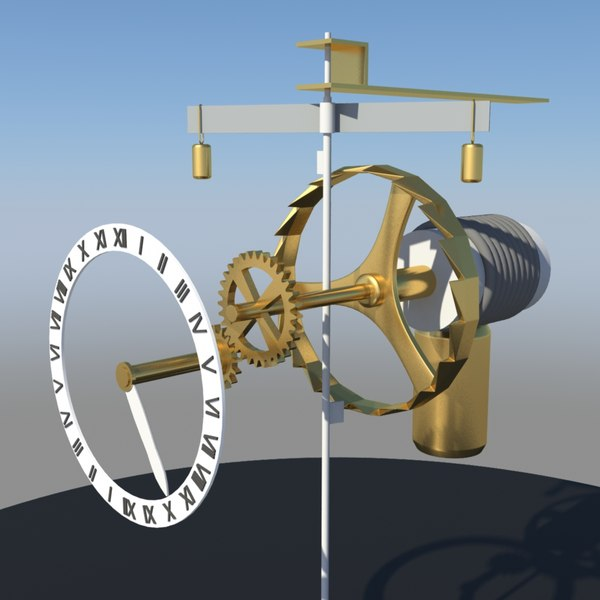
The verge-and-foliot escapement is among the earliest mechanical regulation mechanisms, yet its motion and timekeeping performance remain challenging to predict quantitatively because the device operates through intermittent contact between the crown wheel teeth and the pallets mounted on the verge. From an engineering standpoint, this makes the system highly sensitive to geometry, inertia distribution, clearances, and frictional losses. A modern multibody (MBS) framework—combining rigid-body dynamics, realistic joint models, contact/impact laws, and friction—can provide a predictive tool for understanding how design and manufacturing choices affect rate stability, wear, and efficiency. Such a tool is also valuable for horological reconstruction, conservation engineering, and the design of educational demonstrators that reproduce historical behavior reliably.
Research Objectives
- Build a parameterized multibody model of a verge-and-foliot mechanism, including the crown wheel, verge, foliot, pallets, and representative wheel-train loading.
- Implement contact detection and contact/impact models for tooth–pallet interaction, including friction and optional compliance.
- Calibrate uncertain parameters (friction coefficients, restitution, contact stiffness/damping) using targeted experiments on a simplified test rig.
- Evaluate key performance indicators: mean rate, rate sensitivity to drive torque, energy efficiency, and contact forces relevant to wear.
- Conduct design-of-experiments studies to quantify the influence of foliot inertia, pallet geometry, tooth profile, clearances, and bearing friction on performance.
Methodology
The work will proceed through CAD-based geometry definition, MBS formulation (generalized coordinates, constraints, joint friction), and event-driven contact modeling. Simulation results will be validated against measured angular motion and contact timing obtained from high-speed video or rotary sensing. Parameter identification will use optimization against time series and rate metrics, followed by systematic parametric sweeps to produce practical design maps.
Expected Contributions
- A validated multibody simulation model suitable for sensitivity and design studies.
- Quantified relationships between geometry/inertia choices and timekeeping performance.
- Recommendations for robust, reproducible verge-and-foliot designs and test rigs.
Contacts: michele.vignati@polimi.it