
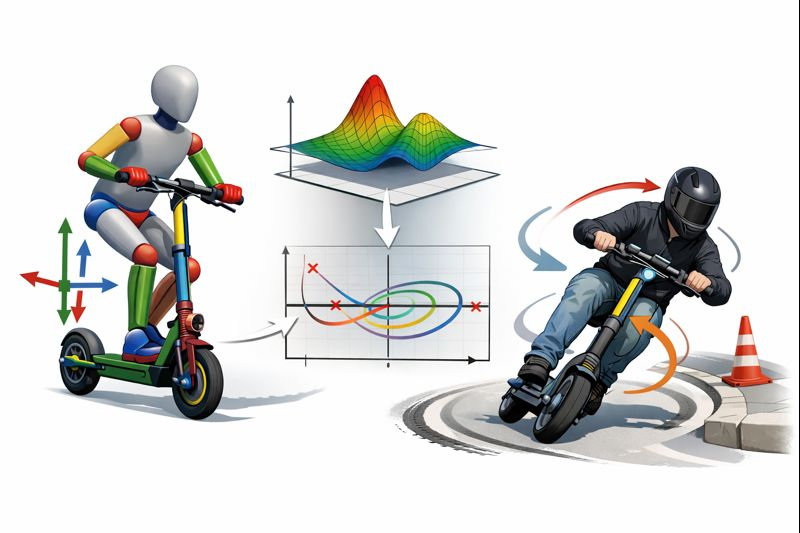
The rapid diffusion of electric scooters as a means of urban transportation has raised significant concerns regarding their dynamic stability and rider safety, particularly in lateral maneuvers such as cornering, obstacle avoidance, and low-speed balancing. Despite their widespread use, the lateral dynamics of electric scooters remain less investigated than those of motorcycles or bicycles, especially from a modeling and stability-analysis perspective. This thesis aims to contribute to this field by developing a comprehensive multibody dynamic model of an electric scooter and investigating its lateral stability through eigenvalue analysis.
The primary objective of the thesis is to study the lateral dynamics of an electric scooter and to identify the key parameters influencing its stability. A detailed multibody model of the scooter–rider system will be developed using a lumped-parameter approach. The model will include the main rigid bodies (frame, steering assembly, wheels) connected through appropriate kinematic joints, as well as tire–ground interaction models suitable for lateral dynamics analysis. Depending on the level of complexity, the rider may be modeled either as a rigidly attached mass or through a simplified articulated representation to capture the influence of rider posture on stability.
Starting from the multibody formulation, the equations of motion will be derived using standard techniques such as Lagrange’s equations or Newton–Euler methods. The model will then be linearized around selected operating conditions, such as straight-line motion at constant speed or steady-state cornering. The resulting linearized system will be used to perform an eigenvalue analysis aimed at identifying the natural modes of the system, including weave, wobble, and capsize-like modes, and assessing their stability as a function of speed and design parameters.
A key part of the study will focus on the influence of geometric, inertial, and tire-related parameters on lateral stability. Parameters such as wheelbase, steering geometry, mass distribution, tire cornering stiffness, and vehicle speed will be systematically varied to evaluate their effect on the eigenvalues of the system. Stability boundaries will be identified, and critical speeds associated with instability onset will be discussed. Particular attention will be given to low-speed stability, which is especially relevant for electric scooters operating in urban environments.
Where possible, the numerical results will be compared with experimental data available in the literature or with simplified test cases to validate the trends predicted by the model. The outcomes of the thesis are expected to provide useful insights into the lateral stability characteristics of electric scooters and to support design guidelines aimed at improving their safety and handling performance.
Overall, this work combines multibody modeling, linearization techniques, and eigenvalue analysis to address a timely and practically relevant problem in vehicle dynamics, offering a solid methodological framework applicable to both academic research and industrial applications.
Contacts: michele.vignati@polimi.it