
Introduction
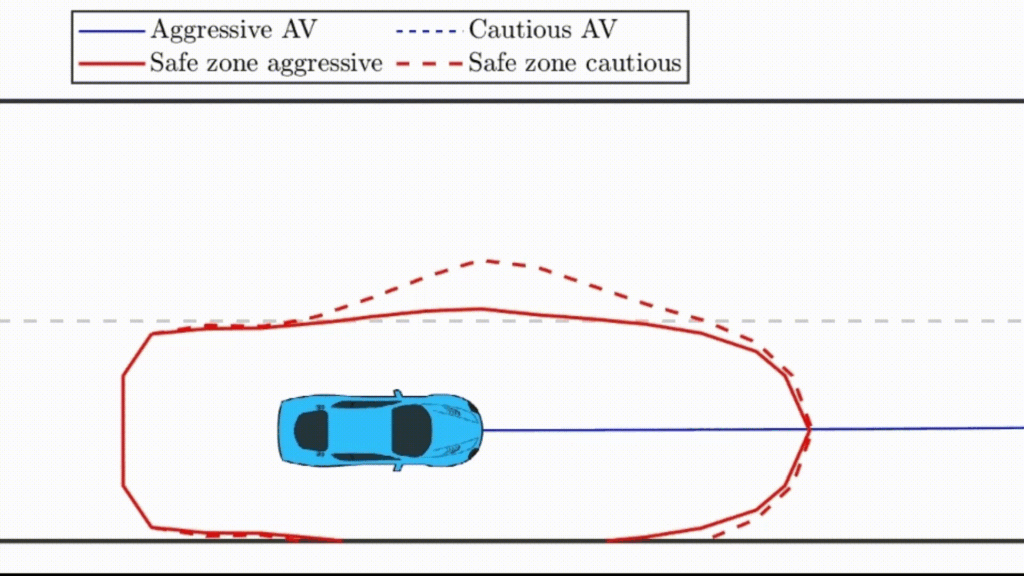
When it comes to the safety of autonomous vehicles (AV), developing algorithms that balance conservatism and performance is the key to achieve methods that allow Avs to be integrated with human driven ones.
One of the most promising techniques is the Hamilton-Jacobi (HJ) backward reachability analysis (based on dynamic programming and differential games), which allows to obtain a measure of the states of a dynamic system from which it is possible to reach an unsafe state (e.g. a collision). However, this method is based on strong conservatism due to the a priori estimation of the danger posed by an external agent.
Goals
This thesis aims to relax the a priori assumptions about the aggressiveness of a human driver and the size of the vehicle, allowing the AV to make safer yet less conservative decisions in real-time. The goal is to achieve an efficient and flexible novel collision avoidance through the infusion of classical HJ backward reachability with state-augmentation, machine learning and neural network techniques.
Validation will be carried out by comparing performance with state-of-the-art and baseline methods.
Requirements:
- Knowledge of Matlab or Python;
- Basic knowledge of control theory, vehicle dynamics and machine learning are a plus (can be learned during the project).
Contact
Marco Doria Fragomeni: marco.doria@polimi.it
Francesco Paparazzo: francesco.paparazzo@polimi.it
Stefano Arrigoni: stefano.arrigoni@polimi.it
For inquiries and further information, please email the first author, copying the other authors in CC