
Introduction
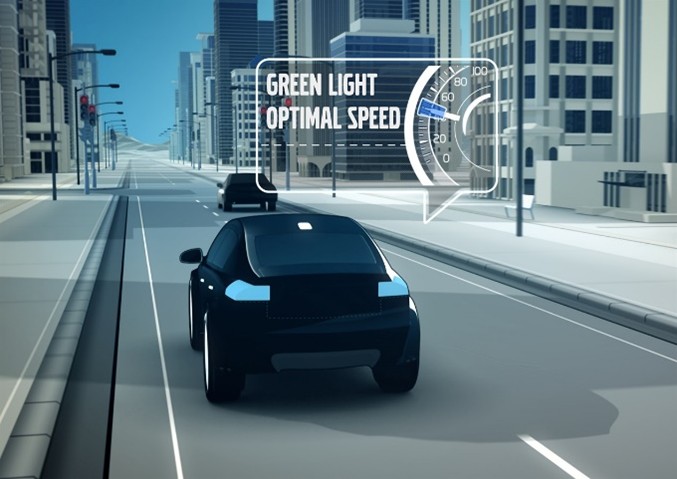
The assessment of solution optimality is a crucial aspect in the design of real-time control strategies for intelligent transportation systems. In the context of Green Light Optimal Speed Advisory (GLOSA), Nonlinear Model Predictive Control (NMPC) is widely adopted due to its ability to handle system constraints and nonlinear vehicle dynamics while operating in real time. However, NMPC solutions for non-convex problems such as GLOSA may end up in local minima, as they rely on finite horizons and computational approximations.
Goals
The aim of this thesis is to evaluate the optimality of an NMPC-based GLOSA system by comparing its solutions with a globally optimal benchmark obtained through offline optimization techniques, such as Dynamic Programming. Although not suitable for real-time implementation, Dynamic Programming provides a reference solution against which the performance gap of NMPC can be quantified. The comparison will focus on metrics such as travel time, constraint satisfaction and energy consumption reduction, providing insights into the trade-offs between optimality and real-time feasibility in eco-driving applications.
Requirements include:
- Familiarity with Matlab or Python;
- optimal control theory (MPC);
- Basic knowledge of ROS or ROS2;
- Additional background in data analysis, simulation is a plus (can be learned during the project).
Contact
Daniele Vignarca: daniele.vignarca@polimi.it
Stefano Arrigoni: stefano.arrigoni@polimi.it
For inquiries and further information, please email the first author, copying the other authors in CC